


Nadya Sheveleva's food will cost a pretty penny
On December 31, my friends and I… are watching the film “The Irony of Fate, or Enjoy Your Bath!” Housewives, cutting salads and listening to the dialogues of the main characters, peer closely: what kind of New Year's table did teacher Nadya Sheveleva set for her fiancé Ippolit? We decided to estimate how much such a “clearing” would cost today and find out how to properly prepare jellied fish so that it would not be rated “disgusting.”
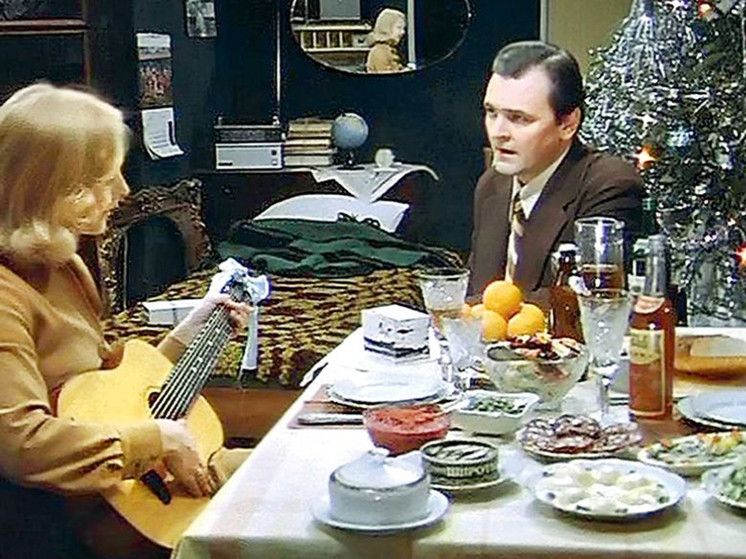
In the film, teacher Nadya Sheveleva admits to an unexpected guest, confirmed bachelor Zhenya Lukashin, that she does not like to cook. But for the groom, the serious and “correct” Ippolit Georgievich, she tried. Judging by the dishes on the table, the hostess spent several hours in the kitchen.
The table, from the point of view of the current average person, is very modest. There is no red caviar, no salted red fish, no seafood, no fresh vegetables. But in Soviet times, this is exactly what the New Year’s table looked like for most people. My mother, for example, said that she would add boiled potatoes, salted mushrooms and open pies.
Young people are now surprised by the can of sprat on Nadya Sheveleva’s New Year’s table. This golden fish in oil was considered a delicacy in Soviet times. Sprats were smoked on alder-beech chips in fish factories in Latvia. If jars of Riga sprats went on sale, they were immediately snapped up. Although they were not cheap. At enterprises, sprats were included in food packages that were distributed among employees. Sandwiches with sprats, pickles and eggs were considered a universal snack. In Soviet times, sprats were placed on the table directly in a tin can, just like cod liver.
“Tin cans have no place on the holiday table,” says leading etiquette expert Yulia Silvanskaya. — Canned food should not be served at all. If someone loves sprats so much, it is better to make small sandwiches out of them. And serve them on a platter. Black caviar should be served in a caviar maker.
On Nadya Sheveleva’s New Year’s table there are also eggs with mayonnaise, sliced cervelat, beet salad (probably with garlic and mayonnaise), and Olivier salad. In the film, when they put Zhenya Lukashin out the door for the first time, Nadya offers to try salad or roast beef.
Roast beef is generally the main intrigue of Nadya’s New Year’s table. Having undertaken to prepare this difficult dish of English cuisine, the hostess, apparently, wanted to hit the groom in the heart.
“It’s really not easy to cook roast beef correctly,” says Alexander Egorov, a chef at one of the restaurants near Moscow. “It’s important to choose the meat.” It is better to take marble; A piece of meat with ribs is also quite suitable. But it should be large — from 1.5 kilograms to three. A small piece will quickly release its juices, and the meat may turn out quite dry and tough.
Ideally, as the expert says, the meat, rubbed with pepper, salt and garlic, should be marinated for several hours. And then fry over an open fire.
— A crispy crust should form on the outside. The meat should remain juicy inside. At home, you can use a deep frying pan for frying. Then the meat is sent to the oven. And they simmer it at 160 degrees for about 2–2.5 hours, periodically pouring over the juice that is released.
Often, roast beef, as the expert says, is served cold. Honey, mustard and olive oil are used for the sauce.
Many viewers tried to look at the roast beef on Nadya Sheveleva’s New Year’s table. I didn’t immediately recognize the cold cuts as an English dish. But this is exactly how roast beef is cut into thin slices. And as a side dish, it is most often served with stewed vegetables or green peas.
Now it’s clear why there was a vase of green peas on the New Year’s table.
It is not known whether Nadya's roast beef was a success. But with the jellied fish, she clearly missed the mark. Hippolytus, pulling a bone out of his mouth, says: “What disgusting, what disgusting, this jellied fish of yours.” Zhenya Lukashin, in turn, notes: “This is not jellied fish, this is… some kind of strychnine.” So why does Nadya’s jellied fish taste bitter? She could buy live fish and, due to inexperience, gutting it, damage her gall bladder. I might not have removed the gills or might have gone too far with bay leaves, which in large quantities produces bitterness.
“Jellied fish is not difficult to prepare,” says chef Alexander Egorov, in turn. — To make your task easier, choose large fish whose bones can be easily separated. You can take pike perch, trout or pink salmon. They are the most affordable now. Clean the fish from scales, gut it, remove the gills, remove the backbone and rib bones. Next you will have to arm yourself with tweezers to remove the remaining bones. Cut the fish into pieces. Add carrots, onions, peppercorns and salt to a saucepan of water (about 1.5 liters). When boiling, be sure to skim off the foam. The broth should be cooked on the lowest heat, barely boiling.
While the fish and vegetables are boiling, as the expert says, pour 30 grams of granulated gelatin with cold water in the proportion as indicated on the package. Let it swell.
— After 30 minutes, remove the fish pieces and vegetables with a slotted spoon. Strain the broth and put it back on the fire. Place a bay leaf in it. To make the broth clear, add the chilled egg white. He, like a sponge, will absorb all unnecessary impurities. In ten minutes the broth will be ready.
Next, the fish needs to be put into portioned molds. Cut boiled carrots there, put boiled quail eggs cut in half, and, if desired, olives, lemon or slices of pickled cucumbers.
All that remains is to combine the hot and strained broth with gelatin, stirring. Next, the lanspik (as the finished mixture is called) is cooled to room temperature. Pour it into molds where fish, vegetables and eggs are laid out, and decorate with sprigs of dill or parsley. And put it in the refrigerator.
Based on the prices of products in a chain store, which also offers discounts, we calculated how much we now need to pay for Nadya Sheveleva’s New Year’s table. A jar of sprat can be bought for 116 rubles, a jar of green peas for 99. Cervelat will cost on average 350 rubles.
The most expensive ingredient in the Olivier salad is doctor’s sausage (320 rubles). For a jar of pickled cucumbers you will have to pay 95 rubles, for a dozen eggs — 114, for mayonnaise — 149. Vegetables will cost a total of 70 rubles, greens — 79 rubles.
Beetroot salad is the most budget-friendly. A couple of large root vegetables can be bought at a chain store for 30 rubles. And to cook roast beef, you have to fork out some money. A kilogram of the required quality beef costs about 800 rubles. You need at least 1.5.
For aspic you need fish. Whole pike perch costs 582 rubles per kilogram, trout — 514, pink salmon — 660. Plus quail eggs (149 rubles), the cheapest olives (78), gelatin (89).
Let's throw another hundred on bread and lemon .
Nadya also has a vase of tangerines on her table. Now you can buy them on average for 140 rubles per kilogram. We also see that the hostess returns home on December 31st with a cake. For a not-so-expensive, but high-quality cake without palm oil, you need to pay at least 600 rubles today.
Nadia has Armenian five-star cognac on her table. Today you can buy it for a thousand rubles. Nadya also bought Muscat wine, which has won many medals. Now you have to pay at least a thousand for it. “Borjomi” in glass, like the one on Nadya’s table, costs about 150 rubles. Judging by the color, the housewife's jug contains apple juice. The package costs 100 rubles.
On New Year's Eve, Nadya asks Zhenya Lukashin to get champagne from the refrigerator, the label says: “Soviet”. Nowadays, semi-sweet sparkling wine can be bought on average for 400 rubles.
In total, a New Year’s table, like Sheveleva’s, will now cost about 7.5 thousand.
Nowadays, you don’t have to cook. A couple of hours before the New Year, the delivery service will bring snacks, hot dishes, and dessert. But something important may be missing — the festive atmosphere itself, when you are preparing culinary delights in anticipation of the celebration, watching how Zhenya Lukashin and Nadya Sheveleva are imbued with sympathy for each other on the TV screen.