


An unexpected way to combat radioactive contamination has been found
Ordinary food and microbial communities have served well in cleaning groundwater from radioactive contamination near the storage facility of the Siberian Chemical Combine in the city of Seversk. A new method of deposition of actinides — uranium, plutonium, neptunium and americium — was tested by scientists from the laboratory of environmental radiochemistry of the Institute of Geochemistry and Analytical Chemistry named after. IN AND. Vernadsky (GEOKHI RAS) together with colleagues from the Institute of Physical Chemistry and Electrochemistry of the Russian Academy of Sciences and the Federal Research Center of Biotechnology of the Russian Academy of Sciences.
 Mineral phase containing uranium after microbial transformation. Photo: Doi.Org.
According to a study previously conducted by GEOKHI scientists, radionuclides can actively spread in sea and river bottom sediments, during suspended particles, in the water itself and benthos (the totality of living organisms living at the bottom of reservoirs).
For example, it was shown that due to nuclear weapons testing and waste dumping into river drains, liquid and solid radioactive waste entered the Kara and Barents Seas from the late 1950s to 1992. 7 sunken nuclear reactors with spent fuel also pose a potential threat (including a partially unloaded reactor from the nuclear icebreaker Lenin).
Scientists also analyzed the results of studying groundwater near nuclear fuel production facilities cycle, in particular, the consequences of the Kyshtym disaster of 1957 (this is a man-made emergency that occurred at the Mayak chemical plant in the closed city of Chelyabinsk-40).
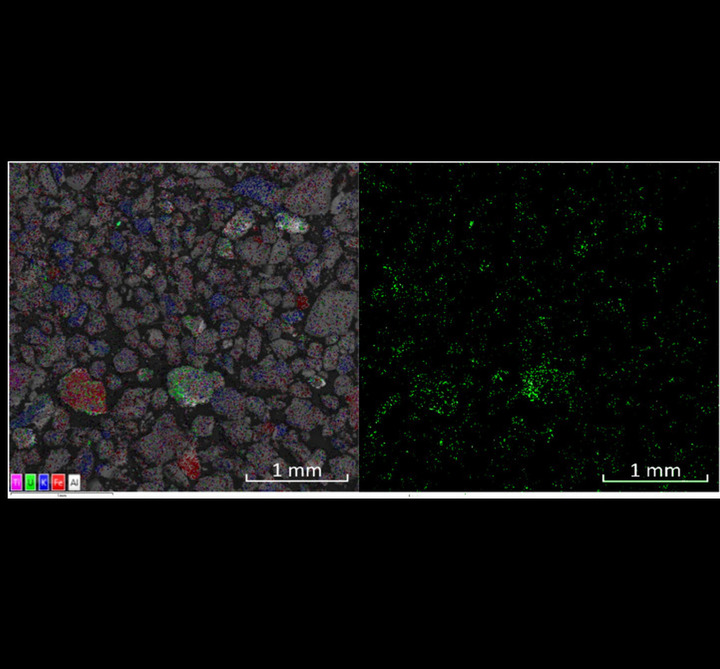 Sample of suspension after microbial transformation. On the right side of the picture are uranium particles concentrated into larger conglomerations. Photo courtesy of a team of authors.
Data obtained on various types of pollution and their scale in different regions of the country, led researchers to the conclusion that it is possible to use the capabilities of natural microorganisms in order to make radionuclides inactive, enlarged for their faster precipitation in biogenic mineral sediments.
In order to check Based on this hypothesis, scientists from the Institute of Physical Chemistry and Electrochemistry of the Russian Academy of Sciences pumped a mixture of sugar and whey through a well into aquifers near the storage facility of the Siberian Chemical Combine in the city of Seversk. This sweet “cocktail” led to the activation of microorganisms, which, as a result of their vital activity, purified water from nitrate ions and blocked the spread of radioactive contamination.
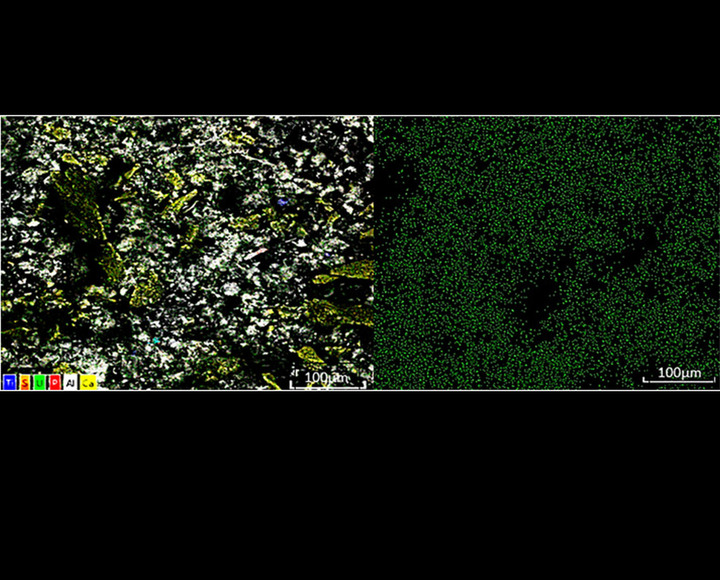 Sample of suspension before microbial transformation. On the right side of the picture is the distribution of uranium. Photo courtesy of a team of authors.
If you take natural water, you will notice suspension, also called colloids, – says senior researcher at the Laboratory of Environmental Radiochemistry of the Geochemical Institute of the Russian Academy of Sciences Ivan Myasnikov. – Under natural conditions, the ability of radionuclides that are attached to suspended particles to spread depends on its quantity and stability. Activation of microbial processes in groundwater with inexpensive organic compounds can provide faster deposition of radionuclides.
Today, after the first tests, it is necessary to comprehend the results obtained, conduct additional laboratory studies, in order to then scale up this approach for other enterprises.
Our new idea, being implemented at the institute, is to transform fine particles through microbial processes into larger and less mobile ones and thereby increase the immobilization of actinides on the rock in the form of new mineral inclusions. In this option, their retention will be more complete and longer. In addition, special additives can be added to the composition of the nutrient solution for injection underground, further accelerating the deposition and fixation of colloidal suspensions on rocks.
– In the future, we plan to evaluate the behavior of actinides in mineral sediments after the bacteria run out of food. The goal of our future research is to deepen our understanding of the behavior of actinides in the environment, which will allow us to apply more effective strategies for cleaning up contaminated sites.