


NASA is aiming to create a whole new “time scale”
Perhaps the greatest, most mind-boggling quirk of our universe is an innate timekeeping problem: seconds tick slightly faster at the top of a mountain than they do in the valleys of Earth. For practical purposes, most people don’t need to worry about these differences. But the renewed space race has seen the United States and its allies, as well as China, rush to establish permanent settlements on the moon, and that has once again brought the peculiarities of time to the fore.
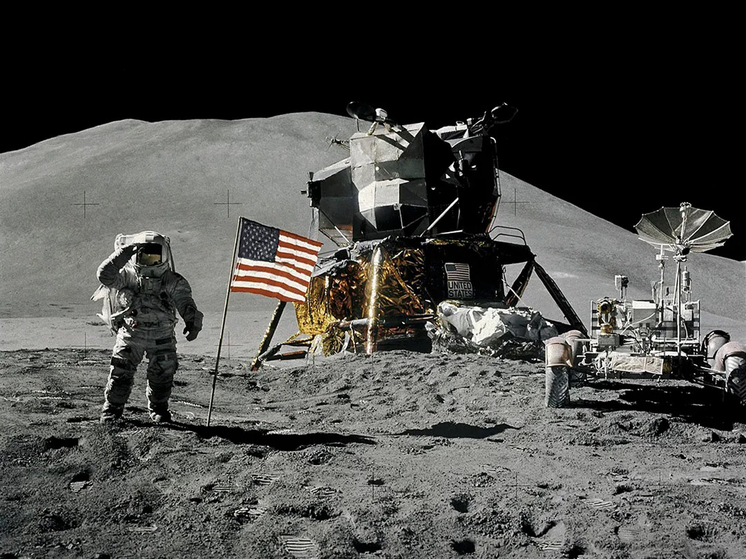
On the surface of the Moon, one Earth day would be about 56 microseconds shorter than on our home planet, — this is a tiny number that can lead to significant timing discrepancies. According to CNN, NASA and its international partners are currently trying to solve this puzzle.
Scientists don't just want to create a new «time zone» on the moon, as some media outlets have suggested, says Cheryl Gramling, a senior scientist in lunar position, navigation, timing and standards at NASA's Goddard Space Flight Center in Maryland. Rather, the space agency and its partners are seeking to create an entirely new «time scale,» or system of measurement, that takes into account the fact that seconds tick faster on the moon, Gramling says.
The agency's goal is to work with international partners to develop a new method of tracking time specifically for the moon that spacefaring nations can agree to abide by.
A recent White House memo also directed NASA to outline its plans for the new time period by Dec. 31, calling it “fundamental” to resuming U.S. efforts to explore the lunar surface. The memo also asked NASA to implement such a system by the end of 2026, the same year the space agency aims to return astronauts to the moon for the first time in five decades.
For the world’s timekeepers, the coming months could be critical in figuring out how to accurately keep lunar time and reaching agreements on how, when, and where to set up clocks on the moon.
Such frameworks will be critical for people visiting our closest celestial neighbor, Cheryl Gramling tells CNN.
Astronauts on the Moon, for example, are about to leave their habitats to explore the surface and conduct scientific research, she says. They will also communicate with each other or control their lunar buggies while on the surface of the Moon.
“When they are oriented relative to the Moon, Gramling says, time must be relative to the Moon.”.
< p>Simple sundials or stone structures that track shadows as the sun passes overhead mark the passage of the day in the same way that the changing phases of the moon can indicate the passage of a month on Earth. These natural timekeepers have been keeping people on schedule for thousands of years.
But perhaps since mechanical clocks became widespread in the early 14th century, watchmakers have become even more picky about accuracy.
Accurately measuring seconds also became more difficult in the early 1900s thanks to Albert Einstein, who shocked the scientific community with his theories of special and general relativity.
“Damn that Einstein — he came up with the general theory of relativity, and a lot of strange things follow from this, – says Dr. Bruce Betts, chief scientist of the Planetary Society, a nonprofit space organization. – One of them is that gravity slows down time.
General relativity is complex, but broadly speaking it is a system that explains how gravity affects space and time, CNN explains.
Imagine our solar system as a piece of fabric suspended in the air. This fabric — space and time itself, which, according to Einstein's theories, are inextricably linked. And every celestial body in the solar system, from the sun to the planets, is like a heavy ball lying on top of a cloth. The heavier the ball, the deeper the crack forms, bending space and time.
Even the idea of an earthly “second” is a man-made concept that is difficult to measure. And it was Einstein's general theory of relativity that explained why time moves a little slower at lower altitudes — because closer to a massive object (such as our home planet) gravity is stronger, notes CNN.
Scientists have found a modern solution to all the complexities of relativity in keeping time on Earth: to account for subtle differences, they installed several hundred atomic clocks at various points around the globe. Atomic clocks are ultra-precise instruments that use the vibration of atoms to measure the passage of time, and these clocks — in accordance with Einstein's theory — tick slower the closer they are to the Earth's surface.
Atomic clock readings around the world can be averaged to give the broadest but most accurate representation of time on planet Earth as a whole, giving us Coordinated Universal Time, or UTC. However, «leap seconds» are sometimes taken into account to bring UTC into line with small changes in the Earth's rotation speed.
This methodical approach, according to Kevin Coggins, deputy associate administrator and program manager for NASA's Space Communications and Navigation Program Keeping track of time helps the modern world go round, figuratively speaking.
“If you have studied time on Earth, you understand that it is a critical factor affecting everything: the economy, food security, trade, the financial community, and even oil exploration. They use precise clocks – Coggins says. – This is present in everything that matters in modern society.
If time flows differently on mountain tops than on the ocean shores, then you can imagine that the further you move from Earth, the more bizarre events become.
Another complication is that, according to Einstein's theory of special relativity, time also moves slower the faster a person or spaceship moves, CNN points out.
For example, astronauts on the International Space Station are lucky, said Dr. Bijunath Patla, a theoretical physicist at the US National Institute of Standards and Technology, in a telephone interview. Although the space station orbits approximately 200 miles (322 kilometers) above the Earth's surface, it is also moving at high speeds — circles the planet 16 times a day, — so the effects of relativity cancel each other out to some extent, Patla said. For this reason, astronauts working in the orbiting laboratory can easily use Earth time to stay on schedule.
For other missions, this is not so easy. Fortunately, scientists already have many years of experience in dealing with such difficulties. For example, spacecraft are equipped with their own clocks, called oscillators, Gramling says.
“They maintain their own time,” Gramling says. – And most of our spacecraft operations — even with spacecraft that are far from Pluto or the Kuiper belt, such as New Horizons — (rely) on ground stations that are on Earth. Therefore, everything they do must comply with UTC”.
But these spacecraft also calculate their own time, Gramling says. For example, devices exploring the depths of the solar system must know — based on your own time scale — when they approach a planet, in case the spacecraft needs to use that planetary body for navigation purposes, she added.
For 50 years, scientists have also been able to observe atomic clocks mounted on GPS satellites, which orbit the Earth at a distance of about 12,550 miles (20,200 kilometers), about one-nineteenth the distance between our planet and the Moon.
< p>According to Dr. Patla, studying these clocks gave scientists an excellent starting point for further extrapolation as they set out to establish a new time scale for the Moon.
“We can easily compare (GPS) clocks with terrestrial ones, – says Dr. Patla, adding that scientists have found a way to smoothly slow down GPS clocks so that they tick in line with the Earth's clock. – Obviously, it's not as easy as it sounds, but it's easier than making a mess.
For the Moon, however, scientists likely won't be looking to slow down the clock. They hope to accurately measure lunar time as it is, while at the same time ensuring it is tied back to Earth time, according to Patla, who recently co-authored a paper detailing the system for determining lunar time.
For reference, the study also attempted to determine exactly how far apart lunar and Earth time are, as estimates ranged between 56 and 59 microseconds per day.
According to the article, the clock on the Moon's equator will be ticking 56.02 microseconds faster per day than clocks at Earth's equator.
What scientists know for sure is that they need to get precision timekeeping instruments to the moon, CNN notes.
Who exactly pays for the moonwatch, what type of clock will be used and where it will be installed are all questions that remain unresolved, says Cheryl Gramling. “We have to figure all of this out,” she said. “I don't think we know for sure yet. I think it's going to be an amalgamation of a few different things.” Gramling notes that atomic clocks are stable over the long term, while quartz oscillators have an advantage in short-term stability. “Never trust one clock,” Gramling added. “And never trust two clocks.”Various types of clocks could be installed inside satellites orbiting the Moon, or perhaps at precise points on the lunar surface that astronauts will one day visit.
As for price, Gramling says atomic clocks are suitable for space flights, can cost about several million dollars, and crystal oscillators will cost much less.
But according to Patla, you get what you pay for. “Very cheap generators can turn off for milliseconds or even 10 milliseconds,” the expert adds. – And this is important because for navigation purposes we need to synchronize clocks to within 10 nanoseconds.
A network of clocks on the Moon could work in concert, reporting the new lunar time scale, just like atomic clocks UTC is used on Earth.
(Gramling adds that there won't be different time zones on the Moon. «There was talk about creating different zones, but the answer was, 'No,'» she said. «But that could change in the future.»)
The new timeline would form the basis of the entire lunar network, which NASA and its allies have dubbed LunaNet.
“You can think of LunaNet as the Internet — or like the Internet and the global navigation satellite system combined, – says Gramling. – This is “a system of standards that LunaNet participants (such as NASA or the European Space Agency) will follow.
“And you might want to think about the idea that the contributors could be, for example, your Internet service providers,” Gramling added.
Creating a platform like this means bringing a lot of people around the world into the conversation. So far, Gramling said, talks with American partners have been “very, very positive.”
It is unclear whether NASA and its partners in this effort, including the European Space Agency, will receive support from countries that are not U.S. allies, such as China. Gramling noted that these negotiations will be conducted through international standard-setting bodies such as the International Astronomical Union.
Accurate clockwork is one thing. But how future astronauts living and working on the lunar surface will perceive time is a completely different question.
On Earth, our idea of a day is determined by the fact that the planet rotates once every 24 hours, resulting in a constant cycle of daylight and dark nights in most places. However, on the Moon, the equator receives approximately 14 days of sunlight, followed by 14 days of darkness, CNN notes.
“On the Moon, things are very different, – comments Dr. Bruce Betts. – And NASA is talking about landing astronauts in a very interesting region of the moon's south pole, where there are permanently lit and permanently shaded areas. So this is a completely different confusion”.
“It won't be easy for astronauts,” adds Dr. Betts. – It's so different from Earth, and it's just a completely different way of thinking.”
This would be true no matter what time it was on the astronauts' clocks. However, accurate timing matters — not only to scientifically understand the passage of time on the Moon, but also to create all the infrastructure needed to carry out the missions, CNN emphasizes.
According to Cheryl Gramling, the beauty of creating a time scale from scratch is that scientists can take everything they learned about timing on Earth and apply it to a new system on the Moon. And if scientists can get it right on the Moon, she added, they can do it right later, if NASA achieves its goal of sending astronauts deeper into the solar system.
“We really hope to get it done on the Moon. «learning everything we can learn,» Gramling says, «so we can be prepared to do the same on Mars or other future bodies.»