


Celestial body helps form planets
At a distance of about a thousand light years from Earth, there is a huge disk of gas and dust that gives astronomers a glimpse of how planets are born. Some may look at the curved outline of the body and see a cosmic butterfly. On the other hand, some may find the layers more reminiscent of a sandwich.
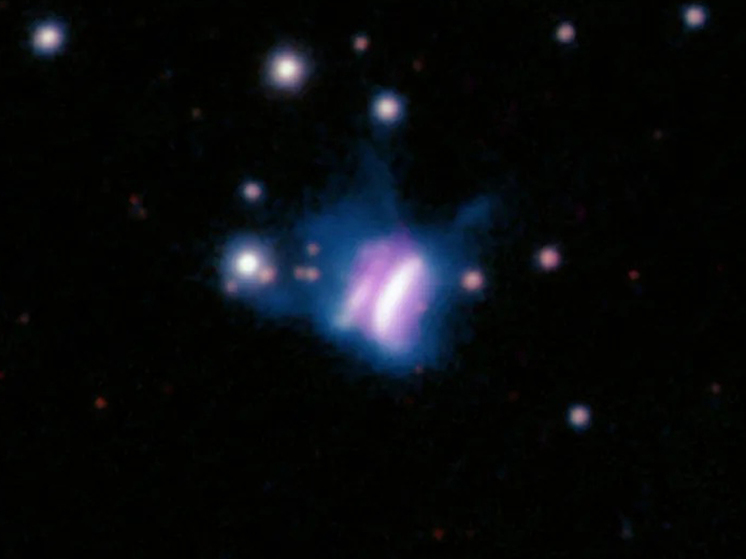 Photo: SAO/ASIAA/SMA/K
US Naval Observatory astronomer Cyprian Bergia first noticed the disk in 2016. Inspired by the title of a similar disc, Gomez's Hamburger, Bergia decided to continue the sandwich theme. At the suggestion of his Uruguayan colleague Ana Mosquera, he called it “Chivito Dracula.” in honor of the national dish of the South American country — meat sandwich, and also in honor of the iconic character, based on a historical figure from his own homeland, Romanian Transylvania.
Protoplanetary disks, as experts call them, are rotating masses of dense gas and dust moving around a young star. Bergia and his colleagues suggested that IRAS 23077 is such a mass. Now a team of researchers from the Smithsonian Astrophysical Observatory and their colleagues have confirmed that «Chivito Dracula» may be the largest protoplanetary disk ever found.
«Bergia was looking for advice on how to interpret this very strange object he had found,» — Monsch admits that launched her search for already published data that could help identify the identity of the body.
Researchers previously identified a protoplanetary disk known as the “Gomez Hamburger,” which was studied using radio telescopes in Hawaii under called Submillimeter Array, or SMA.
Monsch told colleague Joshua Lovell about the research: “I told him about IRAS 23077 and asked if he could help me make some observations of SMA myself.” That same day, Lovell began observing IRAS 23077, receiving clearance for two weeks of observations and first data shortly thereafter.
SMA allows us to observe small dust particles, millimeter-sized pebbles, and carbon monoxide gas that are characteristic components of protoplanetary disks. The data showed that IRAS 23077 contains huge amounts of both, suggesting a huge reservoir of gas and dust inside the disk. The volume of gas and dust could allow the protoplanetary disk to create many giant planets over a large area. Monsch notes that the enormous size of the IRAS 23077 — this is what allowed her and her colleagues to get such good data on the object's composition, since other protoplanetary disks in the sky appear much smaller.
“Many disks are so small that even our best radio telescopes have difficulty resolving them spatially,” — notes astrochemist Dana Anderson. Not only is IRAS 23077 large, she said, but its orientation toward Earth gives researchers a rare glimpse of what's going on inside.
It's possible that planets have already begun to form within IRAS 23077. Curious asymmetries are observed in shadows and brightness along the “wings”.
“We think that one of these shadows may indicate that there is a planet inside the disk that has already formed,” — Monche states. A planet located inside the disk could create a path through it, causing parts of the disk to warp and tilt, casting shadows. Monsch notes that more data from the SMA, the James Webb Space Telescope or other scientific instruments will be needed to be completely sure.
Anderson points out that such planet-forming disks are popular objects to study with telescopes, and she expects that IRAS 23077 will become another object.
Monsch and his colleagues are already starting to find these additional interesting objects. The attempt to identify IRAS 23077 allowed Monsch and his colleagues to begin searching for other protoplanetary disks in the vastness of space. Research on these new disks is expected to be published soon.
While something as fundamental as planet formation may seem well understood, relatively little is known about how it actually occurs. such processes occur. There appears to be a discrepancy between theoretical models of how planetary systems should form and the different forms of planetary systems that experts can observe in space. Studying protoplanetary disks will help experts better understand the different ways planets form.
«By characterizing the composition and structure of these outer disks, which we know can form many gas giants due to their size, we should gain insight about different ways of planet formation,” — concludes Monche.