


The challenges of global climate change are forcing people to look for new ways to prevent it
Federal agencies spend millions annually replacing sand on beaches. Some experts say it's a waste of tax dollars. At the beginning of 2024, in the American city of Wrightsville Beach, the sounds of repair work were heard for two and a half months — pipe that pumped sand equivalent to 100 dump trucks onto the coastline.
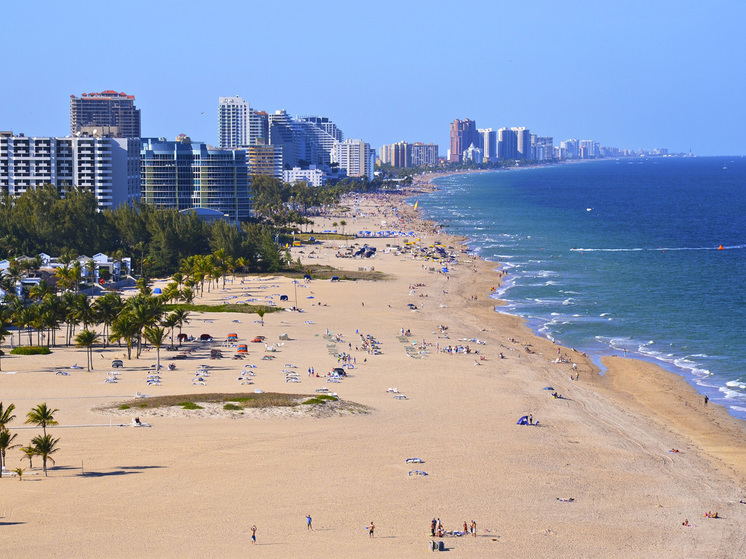
The sand replacement work was part of a beach restoration project aimed at restoring and expanding beaches lost due to erosion or storms. The Wrightsville Beach project, paid for with federal tax dollars and completed by the U.S. Army Corps of Engineers, cost about $15 million and is renewed approximately every four years.
«I really believe that replacing sand on the beach — this is a necessity,” — says American Jeff Degroot, who has lived on the beach in Wrightsville all his life and owns a surf shop. His livelihood depends on the beach, which must be kept in good condition through sand improvement projects.
«The main disadvantage — It's the cost, isn't it? But the benefits outweigh this,” — concludes Degroot.
But some experts say taxpayer money spent on beach sand improvement projects could be better spent elsewhere.
Data from Western Carolina University's (WCU) Developed Shorelines Program shows that over the last century, more than 2,500 beach improvement projects have cost more than $10 billion, or nearly $16 billion in inflation-adjusted 2022 dollars. Not surprisingly, the number and cost of projects tend to increase in years with severe storms.
There were 75 projects completed in 2013, more than in any year since 1923. That same year, Hurricane Humberto and Ingrid, along with 11 other tropical storms, hit the Atlantic coast. Winter Storm «Nemo» also passed along the east coast that year. 2014 produced the largest losses, amounting to about $925 million in inflation-adjusted 2022 dollars. More than three-quarters of all projects included in the Western Carolina University database and analyzed by CBS News were repeat projects.
For example, at Wrightsville Beach alone there have been 27 beach improvement projects since 1939, totaling approximately $107 million in 2022, according to WCU data as of June 2024. On average, this amounts to approximately one project every three years. Much of this work, both at Wrightsville Beach and across the country, is federally funded.
Joe Vietri, director of the U.S. Army Corps of Engineers' National Coastal Risk and Storm Management Planning Center, said the spending are worth it and the return on investment can be significant because these projects deal with coastal risk management.
“Our goal— create a buffer between the ocean and the population,” — Vietri emphasized, citing a study conducted by the USACE after Hurricane Sandy that showed how beaches reduced damage and “became a buffer between the ocean and the population.”
Stressing the importance of a coastal defense system, he added: “Where you had a stable, well-maintained beach, seawalls and dunes, the damage was significantly less than where you didn’t. And I mean it was significantly less.»
The US Congress must approve all federally funded beach improvement projects. According to some experts, this could save money in the long run.
«When a storm hits, the federal government pays a lot of money to come in and fix it, — says Bob Keisler, construction project manager for the US Army Corps of Engineers. He emphasized the importance of taking proactive measures to solve the problem more effectively.
“It's sort of like an insurance policy, a way to proactively deal with storms at a much lower cost today, to provide protection so that when a hurricane approaches, there will be much less damage,” — compared Keisler.
Andy Coburn, associate director of the Program for the Study of Developed Coastlines at Western Carolina University, has concerns about these projects from a public policy perspective. He noted that part of the cost-benefit analysis that no one thinks about is what happens if the beach starts to erode due to factors other than storms, such as natural erosion and sea level rise from climate change.< /p>
Some studies have shown that replacing beach sand may be a viable climate change mitigation strategy, but some scientists have conducted analyzes showing that it may not be the best long-term solution.
Over the past few decades, the increase in the number of beach sand resurfacing projects has led to rising prices. Adjusted for inflation in U.S. dollars this decade, costs have averaged about $490 million per year.
«Over time, as this sand begins to disappear and communities and government will have to help find new sand, this will increase costs even more,” — presses Coburn and proposes a solution that would require beachfront property owners, who he believes benefit most from beach renourishment projects, to cover most of the costs.
Joe Vietri concluded that there are others solutions for homes and buildings themselves that can help reduce risks not associated with sand replacement, such as home extensions. But there are cases when strategic retreat is an alternative, — Vietri gave an example on Long Island: “They are located in the middle of a wetland. So, instead of spending tens of millions of dollars on defense, it might be smarter to just consider foreclosures.»