


An incredible hydrothermal environment was hidden in the depths of the waters
Off the coast of Spitsbergen in Norway, at a depth of more than 3 thousand meters, along the underwater mountain range of Knipovich, which was previously considered rather unremarkable, there are many hydrothermal sources.
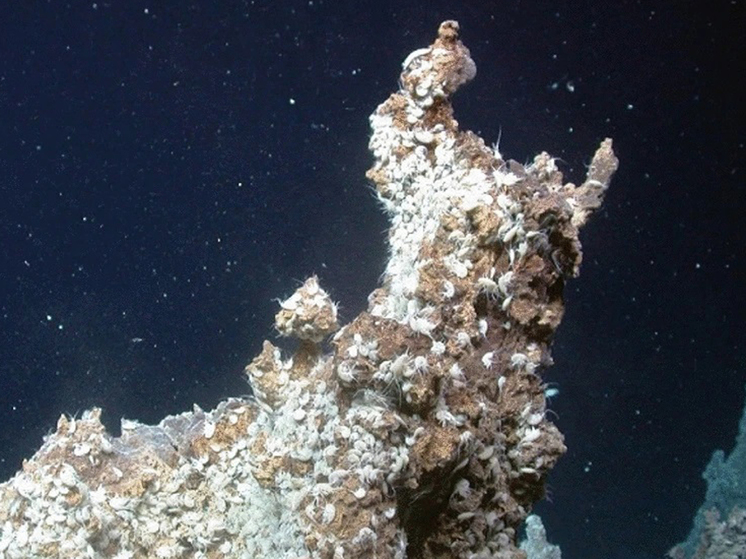 Photo: nature.com
Scientists say volcanic activity beneath the seafloor allows heat to penetrate, creating pockets of heat and chemical reactions where life can flourish.
The discovered field, measuring at least a kilometer long and 200 meters wide, was named Jotul after the giants from Norse mythology who live under the mountains. In this case, the giants are internal processes of the Earth that are released through cracks in the seabed.
“Water penetrates to the ocean floor, where it is heated by magma. The superheated water then rises back to the seabed through cracks and fractures, explains marine geologist Gerhard Bormann. “On its way up, the liquid becomes enriched with minerals and materials dissolved in rocks of the oceanic crust. These fluids often seep to the seafloor through tubular channels called black smokers, where metal-rich minerals are then deposited.»
Hydrothermal vent fields are some of the most interesting places in the underwater environment to study. They are usually found very deep below the ocean's surface, so deep that sunlight cannot penetrate the vast volume of water above them.
At the depths where the incredible environment was discovered, it is constantly dark, very cold and crushing pressure reigns. It's not exactly conducive to life, but the hydrothermal vents act like strange oases. The minerals that leak out and dissolve in the water create the basis for a food web that relies not on photosynthesis, like most organisms living closer to the surface, but on chemosynthesis—the use of chemical reactions to produce energy rather than sunlight.
These conditions create a much more dynamic and prosperous seabed than might be expected, and give scientists insight into how life might arise in such an environment.
Finding hydrothermal deposits is also important to try to protect the Earth's biodiversity and learn more about how it functions, as well as to understand how the planet itself changes over time.
The Jotul deposit is located directly on the border of two tectonic plates of the Earth, on the so-called slowly spreading ridge.
Scientists noticed signs of hydrothermal activity in the region, so they took a remotely operated submersible to a mountain ridge to see if they could find its source.
They lowered the MARUM-QUEST submersible to the seabed more than than 3 kilometers, where he took pictures and took water samples. And there they discovered the Yotul field — a vast area of the seabed with extinct and active hydrothermal vents and the characteristic shimmer of volcanic heat seeping into the water.
“The Yotul hydrothermal field is the first discovered on the 500-kilometer Knipovich Ridge with ultra-slow distribution, and it is of great importance because it represents a new link between the active hydrothermal systems of Loki Castle at the bend of the Mons and Knipovich ridges and the Aurora hydrothermal field on the Gakkel Ridge,” the researchers explain.
In addition, new the discovery could help better understand ocean chemistry and how the waters that make up our world help circulate and distribute substances such as carbon.