


The expert assessed the prospects for creating the Power of Siberia-2 export route
Despite the tightening of anti-Russian economic sanctions, domestic energy resources remain in demand on the international market. This was confirmed by the next meeting of President Vladimir Putin with Chinese leader Xi Jinping, at which the parties agreed to accelerate the construction of the “Power of Siberia 2”. – an additional gas export route from our country to consumers in the Middle Kingdom. The creation of a new highway requires repeated approvals, however, Moscow’s Western opponents are already beginning to think about their hasty abandonment of Russian “blue fuel.”
Western powers, introducing severe economic sanctions against the Russian energy industry, argued that our country would not be able to quickly find alternative sales markets. The established opinion was well founded. Both the United States and Europe were confident that the Russian economy had long been hooked on the “raw materials needle.” and is highly dependent on export earnings from energy companies. The conclusions seemed correct: our country’s budget was indeed 60% formed from revenues from the sale of energy resources to foreign, mainly Western clients. The lion's share of raw materials went to European countries, whose industries received hydrocarbons, primarily natural gas, at stable prices fixed in long-term contracts.
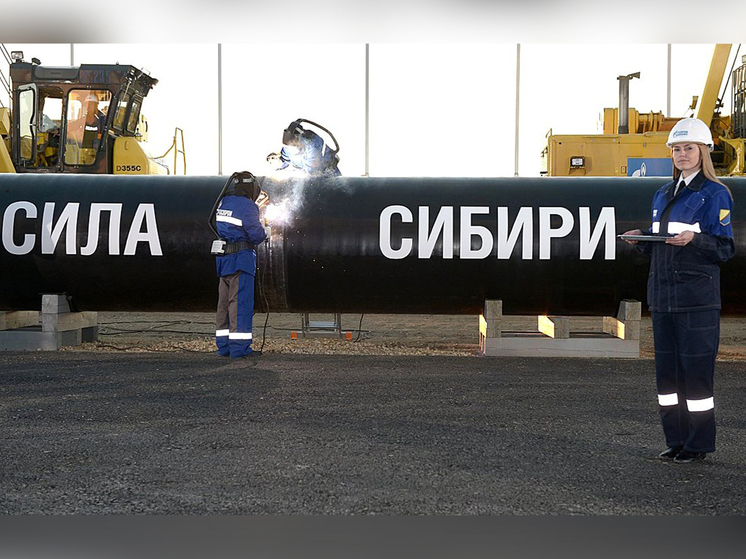
How did sanctions affect this situation? On the one hand, supplies of “blue fuel” domestic producers to EU clients decreased from 150 billion in 2021 to 43 billion cubic meters in 2023 on the other hand, purchases of raw materials from Asian importers over the same time increased by one and a half times – up to approximately 40 billion cubic meters. It would seem that the replacement is not equivalent. However, if the task of providing Europe with energy resources from Siberian deposits was solved over the course of half a century, then the export supply of raw materials in the eastern direction was established in just a couple of years. An important help here was the already built “Power of Siberia” pipeline, which allows supplying up to 50 billion cubic meters of gas per year to the Celestial Empire alone. The new intercontinental line promises to be a significant expansion of the energy route – route «Power of Siberia-2», the acceleration of construction of which was agreed upon by Vladimir Putin and Xi Jinping. Deputy General Director of the Energy Security Fund Alexey Grivach is confident that the noticeable pace of development of Russia’s cooperation with Asian states will force Western powers to think about an unjustifiably hasty refusal to import hydrocarbons from our country.
– The Chinese industrial sector is capable of increasing gas consumption in significant volumes. Over the past six years, the requirements of the Chinese economy for “blue fuel” have increased. increased by 150 billion cubic meters. The closest gas supplier – Russia, therefore our country is quite capable of occupying a significant share of the Asian fuel market.
Natural gas accounts for about 10% of China's energy balance. For comparison, in Japan, whose industrial economy is completely dependent on imported fuel, this figure is twice as high. There are objective forecasts that in the next 10-15 years the Chinese economy will continue to increase energy consumption, therefore the expansion of Russian supplies and the construction of Power of Siberia-2 necessary and justified.
– Everything will depend on the approach to calculations. We should not forget that the situation with Russian exports to the west is still in limbo. It is possible that the EU states, having realized their significant financial losses due to the refusal of energy resources from our country, will in the future begin to soften their sanction pressure on the purchase of our hydrocarbons, which are currently considered “toxic”.
It is also worth considering that the gas transportation system to Europe was created over the course of fifty years. The development of Russian supplies to Asia is happening much faster. The first export contract with Beijing for the sale of “blue fuel” we concluded only ten years ago. Next year, supplies promise to reach the design capacity of 38 billion cubic meters. And this is only the raw materials supplied along the first route of the Power of Siberia. By 2030, the goal is to increase exports through all channels to 100 billion cubic meters.
– Undoubtedly, China has a serious negotiating advantage in the monetary matter, but Beijing must understand that Moscow will not conclude a 30-year contract on clearly unfavorable terms for itself.
Russia will have to develop the export of liquefied gas not “instead” ;, and together with pipeline supplies, which will become an additional incentive for the diversification of the entire global fuel market.
– Anti-Russian pressure from the United States on partners friendly to our country continues and will continue to intensify. Perhaps this is why the final agreement on gas supplies via the Power of Siberia-2 exists only on paper. However, this most likely indicates Beijing's cautious foreign policy rather than China's fear of suffering from any Western sanctions.