


Fossil Belonged to Relative of Woolly Giant
An American has spotted an intact, two-metre-long mammoth tusk sticking out of the bank of the Mississippi River. The huge fossil belonged to a Columbian mammoth, which is thought to be related to the woolly mammoth. The discovery in this area marks the first time an archaeological artifact has been discovered.
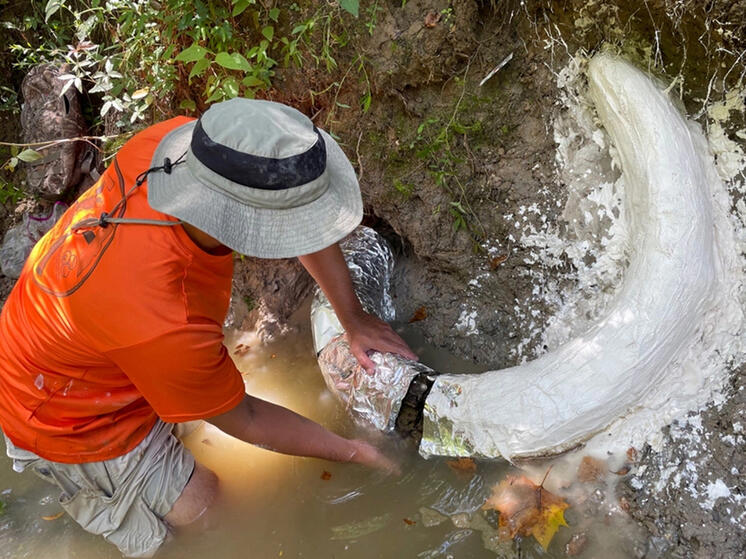 Photo: mdeq.ms.gov
Fossil hunter Eddie Templeton has discovered a prehistoric treasure in rural Madison County along the Mississippi River.
“Until recently, it never occurred to me that this could be the tusk of a mammoth, and not a mastodon. When I found out who it really belonged to, I was even more happy, — Templeton tells the Clarion Ledger. — I had always hoped to find part of a mammoth, but it is very rare here.”
After the discovery, the treasure hunter notified state archaeologists of the find, who removed the mammoth tusk and placed it in a protective “cocoon.” made of aluminum foil, burlap and plaster.
According to paleontologists, three species of proboscideans roamed the Mississippi River region during the last ice age: the mastodon, the gomphothere, and the Columbian mammoth. Each of these animals had tusks, but mastodons were the most common in the region because they could forage for food and live in a variety of conditions. Columbian mammoths were less common in the region, preferring open grasslands and prairies.
Analysis of the remains revealed that the ancient animal lived in southern Costa Rica, and its diet consisted mainly of grass, leaves and flowers. Although Columbian mammoths were the largest species of mammoth, they died out around 11,000 to 13,000 years ago, while woolly mammoths outlived them by around 6,000 years.
«It felt like it needed to be taken out because once it starts to dry out, it starts to flake and can deteriorate quickly,» Templeton explains. — «Our intention from the beginning was to try to protect it, to get it out of the creek and put it in a more favorable environment to protect it.»
According to the Mississippi Department of Environmental Protection, typically when tusks are found in Mississippi, they are only fragments.
The fossil hunter has found rare archaeological sensations before. He has found the remains of giant beavers and saber-toothed cats. But according to ABC News, the mammoth tusk will go down as his best find yet. Templeton believes the most important archaeological artifact is a mastodon jawbone with a row of teeth.
Paleontologists are reportedly waiting for the tusk to dry completely so they can continue their assessment and find out how old the mammoth was when it died.