


Should citizens expect cash gifts from the authorities in the near future
The federal budget is a problematic point of the Russian economy this year. It again became scarce, and the hole in the treasury in the first half of the year is 2.6 trillion rubles. To make ends meet, the authorities have already announced a noticeable increase in public debt and a frontal reduction in unprotected spending items by 10% in 2024. And the sharp weakening of the ruble that happened in July, many experts associate with the interests of the budget: with a cheap national currency, it is easier to fill it. Will the authorities succeed in plugging the hole in the budget? How will it affect the financial interests of citizens? Should the population count on unscheduled indexation, one-time payments or other monetary «gifts» from the authorities? Oleg Buklemishev, Director of the Center for Economic Policy Research at the Faculty of Economics of Moscow State University, Mark Goykhman, an analyst at Capital Skills Financial Academy, and Alexei Zubets, Director of the Center for Socio-Economic Research at the Financial University under the Government of the Russian Federation, were looking for answers to these questions during an online conference at MK.
< p>: — The Ministry of Finance explained the decrease in the deficit in June by the fact that the first months of 2023 budget expenditures were advanced to a greater extent than previously expected. That is, more funds were included in the expenses of past months than now. Accordingly, the average daily item of expenditure is now decreasing. Nevertheless, the current situation does not cause thoughts that everything will be negative, very bad or even catastrophic. Even if we do not meet the planned deficit — this is 2.9 trillion rubles. at the end of the year, — then it will not be exceeded much.
: — What exactly the authorities have reduced spending on is not clear, since the statistics are now closed and we do not see specific areas of spending. But looking at the dynamics and measuring the budget by months, and even more so by days, as it is now done, does not make any sense. Still, the costs are high, and they are extremely uneven. If we recall, for example, last year, in December 3 trillion rubles more were spent than planned. This changes the whole picture of budget execution. I would not be engaged in preliminary calculations and forecasts for the year, but would look at the trend, which, most likely, will lead to a gradual increase in the deficit.
: — In absolute terms, of course, the budget deficit will grow, there is no doubt about it. At the same time, the budget deficit of 4.8% or even 5% of GDP, which formed in Russia in the first four months of 2023, is definitely not a problem. You have to understand where it comes from. The first months of the year — January, February — The Ministry of Finance has advanced emergency budget spending on defense, infrastructure, social benefits … It is clear that the budget deficit is mainly due to the collapse of oil and gas revenues, which fell by more than 40%. Meanwhile, budget revenues from exports will rise. For oil, most likely, too. At least domestic budget collections will not fall. First, there is an increase in GDP — is the development of the economy. Second, inflation inflates budget revenues. Thirdly, the growth of real incomes of the population will lead to an increase in consumer activity. All these circumstances will contribute to revenue collection. Well, in sum, this will lead to the fact that in the second half of the year, from our point of view, the budget will feel to a certain extent better than in the first. Therefore, in relative terms, the budget deficit will most likely not inflate any more.
— Reduction of expenditure items — it's a creative process. So far, the Ministry of Finance is telling budget recipients to decide for themselves where they can shrink. Naturally, we are not talking about social spending, that is, the reduction will not affect benefits, pensions … We are talking mainly about unnecessary spending, for example, investment. In other words, these are expenses that burden now and also create a reserve for future expenses. Such obligations will be cut. Also, apparently, some purchases will be cut, and it is quite possible that departments will begin to reduce vacancies in order to reduce the payroll.
: — First of all, all kinds of investment projects, including development programs, will go under the knife. In fact, when we talk about sequestering the budget for this year, we are not talking about eliminating some programs, but about postponing them to a later time. If we are talking about the construction of new roads, or clinics, or kindergartens in certain regions of the country, then the sequestration will mean that plans for the construction of these facilities will simply be postponed for several years.
: — Not really. We talked about the fact that these industries are classified as protected articles. They are the least of your worries. In terms of reducing funding or postponing it to a later date, you can worry about, say, environmental protection.
: — Social spending primarily refers to the obligations of the state to citizens, including some spending on health care, education, payment of interest on public debt. I think it is impossible to rule out some small shifts in social spending towards minimization. Nevertheless, all social guarantees will almost certainly remain, that is, pensions, salaries for state employees, allowances, scholarships … On the whole, I don’t think that there will be a noticeable reduction in social programs. And unprotected articles will be reduced in the main. They amount to approximately 8 trillion rubles out of the planned total expenditures of 29.4 trillion rubles for the next year. By reducing them by 10%, you can get a savings of 800 billion. I believe that this is the maximum amount of cuts that the Ministry of Finance can make.
: — It must be understood that the authorities have an obligation to ensure that pensions grow faster than inflation. And it will most likely work. There will certainly be some additional expenses for social programs. But speaking in general, most likely, those people who depend on the budget will have to wait. My prediction: some additional distribution of «buns» population will still occur, but only due to either legislative requirements for an increase in pensions, or the need to keep state employees in their jobs.
: — If something was not promised, then it should not be expected. Will there be any payments? Yes, of course they will. Let me remind you that next year — elective. During this period, spending directed at the population traditionally increases by about 1% of GDP. I do not think that this time the tradition will be broken.
: — State support has always been very selective. This is the subject of agreements with the Ministry of Finance. I do not rule out that some additional transfers from the budget may be allocated to some, and not to others. In general, the tendency to increase prices and tariffs is natural, and it is associated not only with the budget deficit, but also with inflationary phenomena. Companies need to look for a level of balance, a compromise between increased costs and the ability to offset them through rising prices. Because it's not always possible. There are restrictions not only on the appetites of companies, but also on the effective demand of the population. It is impossible to increase the tariffs of state monopolies and prices in industries where they are already quite high.
: — Companies that fulfill the state order, especially those associated with a special operation, of course, will receive direct funding from the budget. And there will definitely be no increase in prices for their products. Strategic companies, on which the functioning of the country's economy depends, can also count on assistance from the budget — some soft loans, financing and so on. Everyone else will have to survive by increasing prices. Another thing is that prices for natural monopolies are regulated. The government, refusing to raise prices for heat, gasoline and housing and communal services, will simply force these companies to work at a loss for a year and postpone the increase in tariffs to the next year. This has happened in Russia before, and more than once — Let's say during a pandemic. You also need to understand that indexing is a year late. Prices rise today, and compensation for the increase in these prices occurs only next year. Therefore, if the price increase is higher than planned, ordinary consumers will pay for it.
: — There is no extra money in the budget right now. But at the same time, many industries that play a significant role in terms of the special operation and the strategic development of the country will be supported to the extent that they need. They will not be denied any funding. At the same time, the volume of state support is obviously being reoriented to certain sectors and groups of enterprises. All the apocalyptic economic forecasts of the past and this year did not come true. Apparently, our economy will grow. Oil and gas revenues are already on the rise. And if so, then the government may consider that it is not necessary to support this economic growth. Something itself is «boiled» in a certain way; and working. So those who did not receive state support before will not receive it now.
: — The budget deficit in half a year or a year leads to an increase in inflation. The state increases the amount of money in circulation to cover the deficit, increases borrowing, rates. All this leads to a depreciation of the national currency, an increase in inflationary indicators. On the one hand, state employees, pensioners, the poor receive these funds, but, on the other hand, prices are rising. Such funding is largely depreciated due to inflation caused, among other things, by the budget deficit.
: — The consequences of getting used to a budget deficit are subtle at the beginning, but over time they become chronic. Recall the 90s, when everyone said «deficit of 5 & ndash; 10% — it's okay, we'll survive it, but it all ended in a devastating crisis, default and the need to seriously cut costs. I hope that the lesson learned then was well learned by our authorities. Now the budget deficit does not look so deadly. I expect 5 & ndash; 6 trillion rubles a year. This can easily be financed both from reserves and from the balances that are available in the treasury. The situation will become a problem when the chronic deficit passes to the next year, then to the second, third. Then it will be clear that it will not be possible to cover it only with borrowings. It will be necessary either to take away money from those who are already «sitting» on them, — budget recipients, or raise taxes.
: — For ordinary people, the budget deficit — this is more of a boon than a problem, since the government spends more money on social needs, on the development of industries, on infrastructure. It turns out that in the short term (2-3 years) there is nothing wrong with a budget deficit. But you should always remember about the long term: if debts continue to accumulate, then in the future, in 15-20 years, this may lead to the bankruptcy of the state. It will be fatal for the Russian economy.
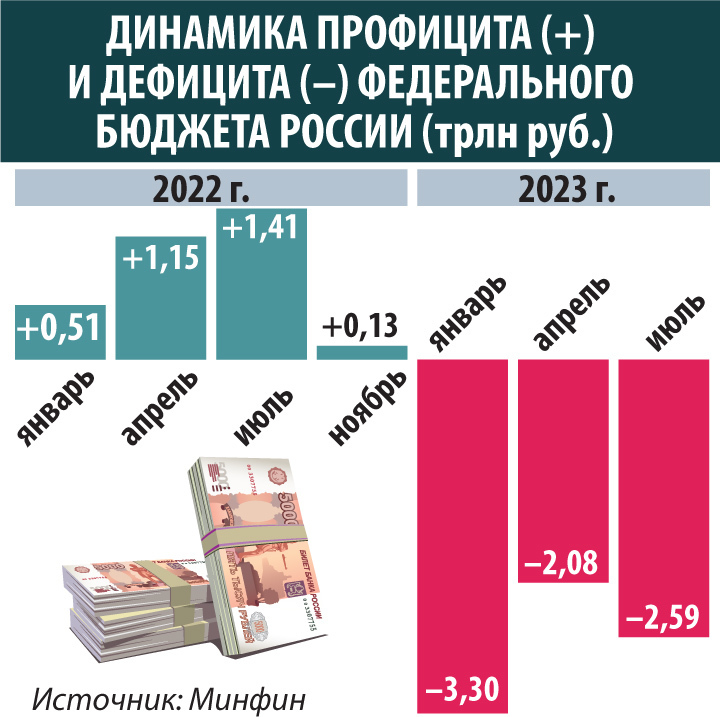
(trillion rubles)
January 2022 +0.51
April +1.15
July +1.41
November +0.13
January 2023 -3.30
April -2.08
>
July -2.59
Source: Ministry of Finance