


The expert said when to wait for the «green» at 100 rubles
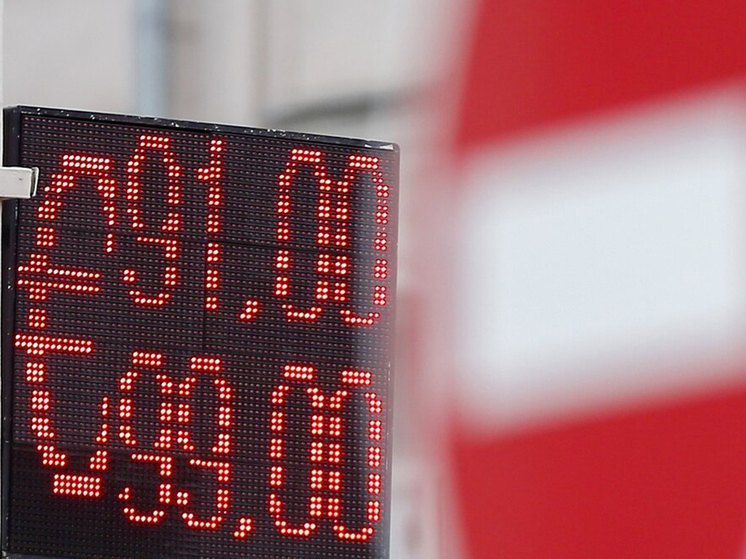
The dollar continues its victorious march to the peak values of last year. At the auction, the American currency reached the level of 95 rubles. For a euro on the Moscow Exchange they give 104 rubles. The last time such values were in March last year, when the market was in a fever after the introduction of a large package of sanctions. Now economists and regulators are talking about the normalization of the economy. Why the national currency continues to fall and when the Russians see the dollar for 100 rubles, Maxim Osadchiy, head of the analytical department of the BKF bank, told MK.
— Both the Central Bank and the Ministry of Finance point out the worsening terms of foreign trade as the reason for the weakening of the ruble. Let me remind you that on July 21, the head of the Central Bank, Elvira Nabiullina, said that the main factor in the movement of the national currency exchange rate in June-July was the consequences of the decline in exports that took place over the past few months, while imports increased at the same time.
Later, on July 31, the head of the Ministry of Finance Anton Siluanov also noted that the weakening of the ruble is primarily due to the trade balance — the inflows and outflows of foreign currency to and from Russia. Now imports have recovered, and prices for exported goods are below last year's level.
According to the Minister of Finance, this is especially evident in gas prices — last year there were moments when they were five times higher than the current level. Why exports are falling is understandable: because of the sanctions. The flow of gas to Europe has declined sharply. In addition, a ceiling of $60 per barrel on Russian oil was introduced.
— Partly due to the formation of new logistics supply chains for imports to Russia to replace the old ones destroyed by sanctions.
< p>Another reason is the rise in the cost of imports, because goods from the United States and Europe have to be imported along more difficult routes, and they have to be shared with intermediaries. In addition, financial schemes for paying for imports have become more complicated. All this leads to an increase in the costs of importers and is reflected in the price of imports.
There is another reason: the warming up of the Russian economy, the recovery of economic growth. Accordingly, demand is growing, including for imports.
— Yes, first of all, by increasing government spending. This growth led to a federal budget deficit, which amounted to 2.6 trillion rubles in the first half of the year, against the planned level of 2.9 trillion rubles for the whole of 2023. Comparing the expected GDP growth of the Russian Federation in 2023, which, according to the forecast of the Central Bank of the Russian Federation, will be equal to 1.5-2.5%, that is, it will grow by 2.3-3.8 trillion rubles, with a budget deficit, we see that government spending is the driver GDP growth. Public procurement for the first half of 2023 amounted to 3.6 trillion rubles.
— First of all, through the sale of liquid assets of the National Wealth Fund (NWF): gold and foreign currency. In 2022 and the first half of 2023, its liquid assets decreased by 1.6 trillion rubles, or by 19.2%, to 6.8 trillion rubles. For the first half of 2023, the volume of gold in the assets of the NWF decreased by 42.9 tons or 7.7% to 512 tons as of July 1, 2023. The volume of the Chinese currency fell by 27.4 billion yuan, or 8.9%, to 282.3 billion yuan on July 1, 2023.
In addition, the federal budget deficit is financed by the «printing press». The annual growth rate of cash in circulation reached 26.8% as of July 1 — an additional 3.8 trillion freshly printed rubles poured into the economy over 12 months. Let me remind you that in December there was a sale of the euro by transferring the currency from the account of the Ministry of Finance to the account of the Central Bank of the Russian Federation, and both departments are under sanctions and cannot do anything with the toxic currency. But at the same time, the currency was purchased for a colossal amount of «freshly printed» rubles, which immediately rushed into the economy.
— It is not the budget deficit itself that negatively affects the ruble exchange rate, but its financing through the emission of money.
— If the trend does not change, then in the coming months, if not weeks.
p>
—Everyone must make their own decision. Let me remind you that the dollar remains a toxic currency in Russia, and the economy has already headed for de-dollarization for a year and a half. For example, a return to the Soviet-era ban on the storage of foreign currency is not ruled out.
In any case, I believe that it is necessary to carry out currency diversification of savings, regardless of the current situation. I recommend keeping 30% of assets in rubles, dollars and euros, another 5% in gold, and the remaining 5% in exotic currencies, cryptocurrencies, stocks, etc. Accordingly, as incomes come in, it is reasonable to invest in this proportion.
Moreover, rubles can be kept on deposits in Russian banks. But foreign currency deposits, as long as the restrictions imposed on them by the Central Bank, are unreasonable to open in Russian banks.