


The MK reporter made a difficult journey to the peninsula
We were dissuaded from a summer trip to the Crimea by all our inner circle: “The situation has heated up, it's dangerous! Where is it taking you?!» And we answered: “Many people go, they are not afraid. Are we any worse? Yes, and children need to improve their health before school. Although, I confess, doubts, of course, prevailed. The MK reporter, at her own peril and risk, tried to get to the peninsula along a new route — through the annexed territories. And arrived. How risky it is, what you should take with you on the road, and what you should not do on the road in any case — read in our material.
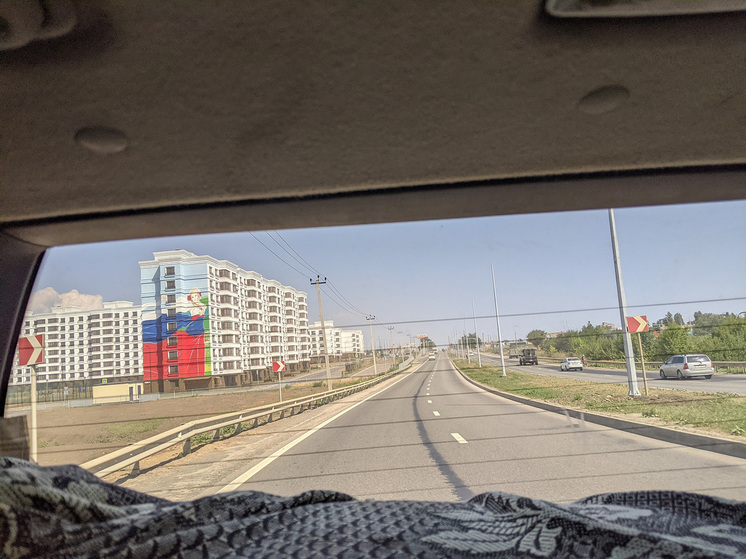 New Mariupol microdistrict as a breath of fresh air
Back in early summer, I started monitoring official groups in instant messengers dedicated to real-time travel across the Crimean bridge. And after another damage to it by Ukrainian surface drones on July 17, I also joined a group where people shared their impressions of traveling along an alternative route — territories annexed to Russia.
There were a lot of horror stories there: they wrote about the curfew, until which it was time to slip through, about military checkpoints, traffic jams at the checkpoint. And this was understandable, because the land corridor runs in the NWO zone. The last phrase is enough to understand the situation.
Therefore, for those who doubt whether to go or not to go to Crimea today, I will cite one typical dialogue that happened in one of the groups. The woman asked a question in the chat: “Help me make a decision: we booked a ticket to the Alushta sanatorium in the winter for August. We are planning to leave in a few days. We have two babies. Please advise if it is safe for us to go.»
 Mariupol Today
Just a few minutes later, one of the participants in the discussion (also a woman) wrote a very wise message in response: “Since you have children, it means that you are an adult. Therefore, we must understand the main thing: everyone who travels to Crimea today, of course, is at risk. No need to have illusions. You have to decide for yourself if you are willing to take the risk. After all, these are your children.»
In general, we decided to take risks.
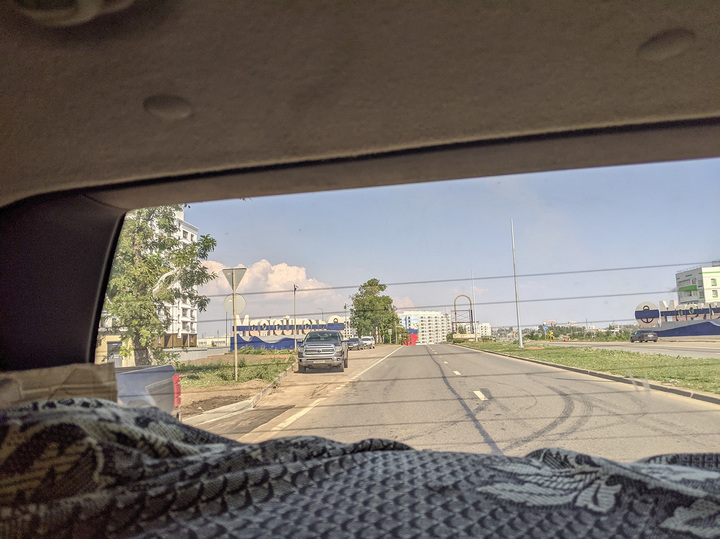 The new district of Mariupol as breath of fresh air
The day before the start by car to the Crimea, they discussed two route options: through the Crimean bridge or along an alternative land corridor. We agreed to make a final decision after a halt and an overnight stay in the Rostov region, in the city of Shakhty. This place is a stone's throw from the expressway to the south — M4.
On our previous trips, we often made a halt in the Ayutinsky microdistrict in a guest house. This time we didn't book the place in advance, they called there only a day in advance. The hotel employee explained that there were only a few double rooms at a price of 2700 per day and one 5-bed room for 4000 rubles. As a result, we easily booked a one-room apartment with all amenities nearby — in the neighboring Internatsionalny microdistrict at the price of a 2-bed room.
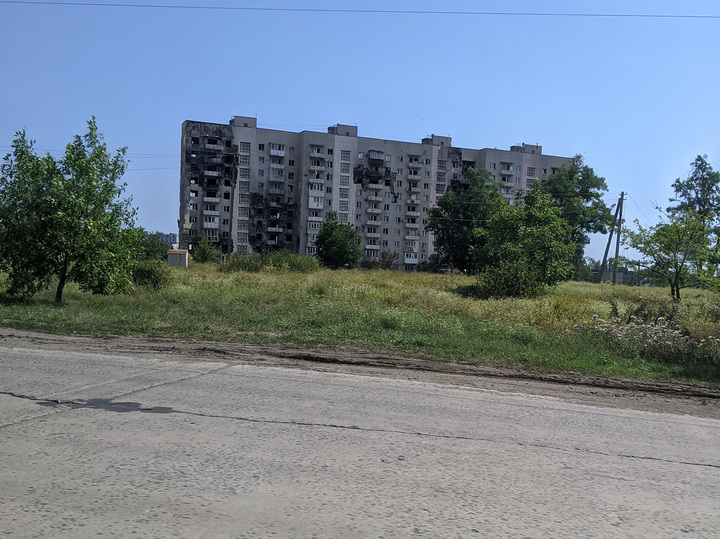 Mariupol today
Most the best departure options: from Tuesday to Thursday, early in the morning, before the morning traffic jam, or after it. Then there will be much fewer cars on the highway than on other days and hours. And you will arrive at the place of overnight stay before dark.
And do not forget to drive your iron horse to a car service on the eve of the trip for inspection: God saves the safe. And also download offline maps of the DPR, Zaporozhye and Kherson regions in advance in case you suddenly choose the second option.
We downloaded it in advance. Be sure to take cash. The card payment system at a gas station, in a store, a cafe can fail at any time.
As usual, we took on the road a standard “gentleman's” set verified over the years: a first-aid kit with medicines (each one has his own), two five-liter canisters: one with drinking water, the second with tap water, antibacterial wipes, a knife, nuts, dried fruits, raw smoked sausage, hard cheese, two liter thermoses, ginger, turmeric, red hot pepper powder (to be added to tea to stimulate the immune system). The three of us started from Moscow on Thursday, August 3, at 8.30 am.
We went to the Voronezh region according to the schedule at an average speed of 90-110 km per hour along the free highway M4. By lunchtime, the sensor in the cabin already showed 33 degrees overboard.
Trouble happened in the Upper Mamon area of the Voronezh region. First, the fuel control light came on, and a minute later our Nissan X-Trail began to suddenly stop. Literally at the last speed, we reached the curb and stood up.
Thanks to the information boards on our way — they periodically reminded us what to do in case of a problem: stop and call the emergency commissioner at a single number *2323. We used this service for the first time, and it works.
The operator replied that all the commissioners are now busy. But in half an hour, help will definitely come. While we waited, we experienced unpleasant sensations: the sun was burning all around, and we were sitting in the “iron box”, as if in a trap. The saloon was inflamed. Cars were rushing past, and the car was shaking from air turbulence.
When it became unbearable, they decided to hide in the nearest bushes. But for this we had to overcome a roadblock. They waited a little more than half an hour for the commissioner. We perceived his appearance as a sudden cool rain in the desert. “And you are my third with such a problem today,” the long-awaited savior Sergey said right off the bat and poured 10 liters of 95 into our gas tank at a price of 56 rubles per liter. We were happy.
 Payman to the rescue
And Sergey gave advice for the future: “If you are driving in the heat, do not wait for the light to come on. Sensors, too, «go crazy.» Better navigate by the arrow of the fuel indicator.
If it approaches a minimum, look for the nearest gas station. And before leaving on a long journey, be sure to replace the air filter in the car. In summer, it quickly becomes clogged with dust and insects. And this affects fuel consumption.”
The next part of the journey was uneventful. But due to the loss of time (taking into account the stop also for a snack), we entered Shakhty when it was fairly dark. It gets dark early in the south.
We recovered well overnight. By the way, do not forget to activate the tariff on the peninsula in advance on your phone. I connected it already in Shakhty.
The owner of the apartment said that a family returning from the Crimea spent the night here yesterday. Everyone was cheerful and relaxed. I thought it was a good sign.
As soon as the first roosters woke up, I went out into the city. Rode for several hours. I tried to talk to everyone who met on my way. “Are Rostovites afraid to go to Crimea?” I ask a local resident Oksana. “Yes, who is like. My relative and her family were driving along the Crimean bridge in July at the moment when it was attacked. She told how they all got stuck. And the secret service officers made a detour, took away the registrars from the drivers and forced the passengers to delete the “extra” photos on their phones, Oksana began to talk. “I don’t need to go to the Crimea. Here on the Don you can perfectly sunbathe and swim. It's quieter here.»
In a pharmacy, a saleswoman shared her observation: “Usually every year people come here for pills, some go to the peninsula, some go in the opposite direction. We are next to the highway. But this year there were no «Crimean» visitors at all. You are the first. Yesterday, the family was returning from Anapa with rotavirus. They bought a whole bag of medicines from us.”
In the grocery store, the saleswoman was sitting at the counter and diligently writing something on a piece of paper. I asked what she was writing: “I am writing prayers. We have a large group here — about 500 people so far. But people come every day. We form parcels to the NWO zone. In each we put a leaflet with a prayer. And on weekends we prepare food for the frontline: we bake pies, steam-cook something tasty for our defenders. My heart hurts for the guys. Let them feel our warmth. It's easier.
Old women were standing at the store with the cozy name «Romashka» to the left of the entrance. Each sold something from her garden. I approached and began to collect pink tomatoes for the road at a ridiculous price — 30 rubles per kilo — with the words: «We are going to the Crimea, but the road is not close.» Grandma sympathetically, kindly looked at me, sighed and quietly wished: “God help you!”
There will be dry, disciplined lines. Because this road goes through regions where martial law is in effect.
As an exception, for the convenience of travelers like us, the curfew has been lifted only on this highway until further notice. Yes, on the side of the road we met several information signs, where it was written: “Attention! Don't stop on the sidelines. Mined. They shoot.
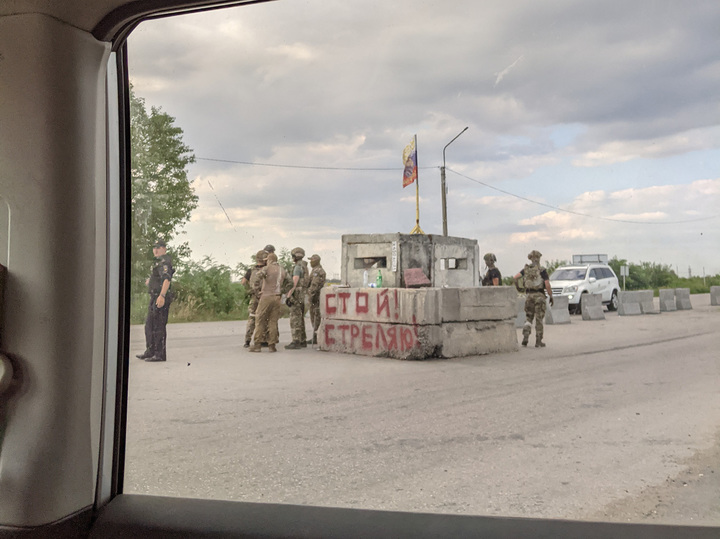 At the checkpoint
It is necessary to keep in mind that to the north, some 150 kilometers, there are battles. Yes, there are many checkpoints, but they carefully check the documents and inspect cars only at two: at the beginning of the route at the Novoazovsk-Veselo-Voznesenka checkpoint and at the end at the Dzhankoy checkpoint. You will need to show passports and birth certificates for children. At both checkpoints, the delay was within half an hour.
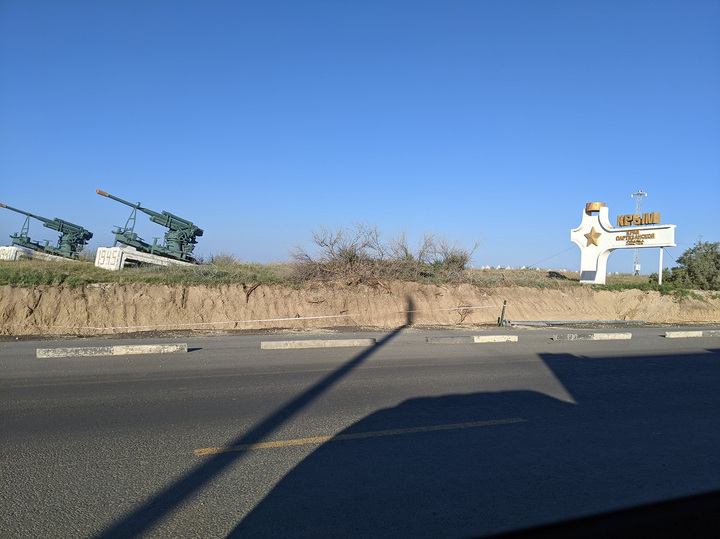 At Dzhankoy checkpoint in front of Chongarsky bridge
There is a lot of military equipment in both directions, including Urals and KamAZ trucks. On the way we met the installation «Grad» and even a tank. Several helicopters and a military aircraft were seen in the sky. They all followed at low altitudes.
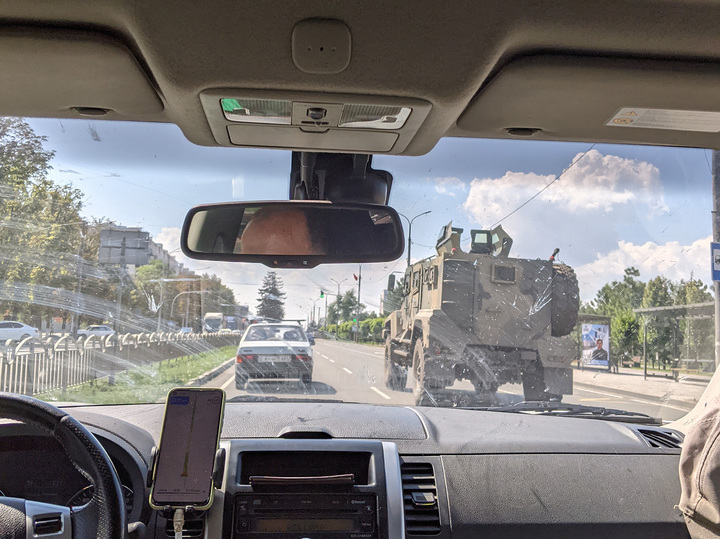 On the streets of Mariupol
There are military police and the commandant's office on the highway. So keep your documents handy. At checkpoints, traffic is reversed. At intermediate checkpoints, we were practically not stopped. On separate ones, they slowed down the maximum to look into your eyes and inside the cabin. Many drivers give the inspectors “goodies”: water, good cigarettes, cookies, etc. The guys take, smile, thank. But no one specifically asks. Not allowed.
So, the reference points of the route: Taganrog — Novoazovsk — Mariupol — Berdyansk — Primorsk — Melitopol — Dzhankoy. The length of the path is about 400 km. The speed of passage, taking into account braking at checkpoints, is 6-7 hours. The road surface is excellent. Somewhere there is a weak markup. Therefore, if you decide to take the land route at night, it will not be comfortable everywhere.
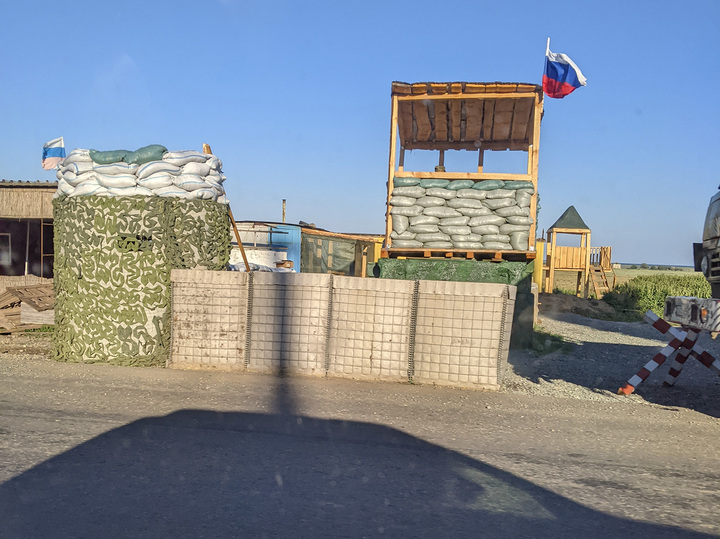 At the checkpoint
There are no speed cameras here, so we were moving at an average speed of 100–120 km/h. OSAGO and Casco until the New Year on the track are not valid. So if you get hooked somewhere, take it for granted.
There were few passing cars, there were trucks, we overtook them in the opposite direction. By the way, about gas stations. A few hours after leaving the Shakhty, we refueled to a full tank, before reaching the first checkpoint. So calmer. Fuel was enough for the entire route to the entrance to the Kherson region. But if you flew through the gas station — it does not matter. On the way, they meet every 50–70 km. Some even in a row.
 At the checkpoint
The Internet went down shortly after passing the Novoazovsky checkpoint. Approximately in the same place where a first aid station with rows of large tents is located to the left of the road. Before Chongar, we moved on offline maps. Cellular communication worked almost everywhere.
If you get hungry, you can have a bite to eat in restaurants and cafes in Mariupol, Melitopol, Berdyansk. The road crosses the last two cities from the edge, so you need to plan a check-in there in advance. In the same points you can stay overnight in hotels. Prices for food and lodging are very low.
More than a year has passed since the fighting in Mariupol subsided. The air was filled with the smell of fruit from abandoned orchards on the outskirts in the private sector. The streets were filled with military vehicles for various purposes. They stood on the roadside and moved along the roads in the stream among the cars.
We stopped in the Levoberezhny district, on Merzlyaka Street, near one of the buildings with a huge charred hole in the wall. The mangled gates hung down into the courtyard. And on the ground lay books mixed with rags and boots. Next to it are rows of high arches, «up to their ears» overgrown with grass and strewn with bunches of grapes. He glowed in the sun. And it seemed that bones were visible inside the fruits, as on an x-ray.
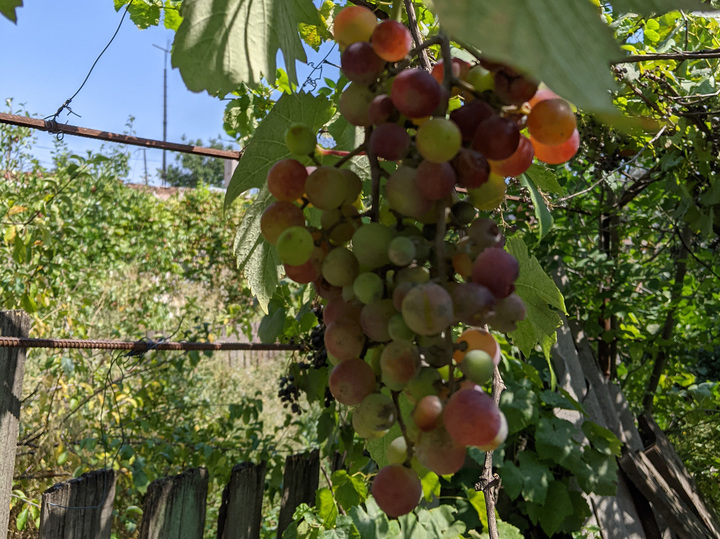 Everything sings, but there is no one to eat < span itemprop="width" itemscope="" itemtype="https://schema.org/QuantitativeValue">
There was a tree in the distance. Its branches, hung with large burgundy pears, bent to the ground. Their sides shone, but there was no one to eat them. Who lived here? Planted it all? And where are these people now?
I looked at abandoned houses, frozen in time. They looked like a seriously wounded man who is so ill that he does not have the strength to ask for help. These clots of trouble will be dissolved in time for a long time, touching everyone who comes here. But the wounds will someday heal, and everything will return to life.
On one of the gates I noticed an inscription in white paint “People live here” — as if a fresh breeze blew. The ground in the yard was well-groomed, sunflowers and pumpkins bloomed. In the distance, a woman in a white shawl was rummaging in the ground. It seemed to me that she cut dry, damaged branches from a fruit tree, and then broke them into small pieces. Her movements were decisive and quick, as if she was tearing the past time into pieces with her own hands.
I recalled the lines of the poet Dmitry Melnikov, dedicated to the dead soldiers who liberated Mariupol: “Write me later, as if alive, a letter, but write about happiness, not about grief. Write to me about what you see through the window the endless blue sea. I broke this time with my hands like steel, kissed him on black lips, write about love, don't write about sadness, write that I took Mariupol.
Then we drove along Lenin Avenue. People went about their business, traffic lights, shops and cafes worked. We gave way to a military «Ural» moving off to the left. And the driver raised his hand in greeting and thanked in response. Outside the window flashed charred high-rise buildings. Construction cradles with workers hung on some of them. I saw in contrast a clean, like new, 9-storey building. Only on the last floor, instead of a window in one of the apartments, a black hole gaped: a shell had hit here.
 The New and Destroyed Bridge over the Kalmius River
Then we drove through a temporary structure across the Kalmius River. On the left, pieces of a broken old bridge hung, on the right, a new one was being built. When we drove past the newly rebuilt beautiful microdistrict of Mariupol, there was confidence in the future. Tall white high-rise buildings looked festive against the bottomless blue sky.
When we left the city, our impressions changed. There were so many military vehicles in both directions that they quickly got used to them. Here, on the side of the road, fighters are repairing an armored personnel carrier, but on the left is a column of buses, accompanied by a traffic police patrol car with flashing lights. On both sides, burned-out equipment was encountered on the roadsides: whether military, or civilian — it’s hard to understand right off the bat. On both sides, there were periodically rows of defensive lines extending towards the horizon.
The checkpoint in Chongar passed in 20 minutes. Serious psychologists work there: men and women with attentive, piercing, like an X-ray, views. They try to talk you into conversation, joke, smile, but in the depths of their eyes, the utmost and harsh seriousness froze. I asked the employee who was inspecting our car with a long-handled mirror: “Are you calm here?” He rolled his eyes mysteriously, “Six hours ago, something flew in. Somewhere there they shot down,” he waved his hand to the side and smiled broadly in parting: “Happy journey!”
 Zone inspection in front of Chongarsky Bridge
After Checkpoint in Chongar, the road went bumpy. But that didn't matter at all. Feelings were bursting. In Crimea! Got there! We were driving through the Kherson region, along a shaking road and rejoiced.
But our path lay in the southern part of the peninsula, where our loved ones were already waiting. They were there by midnight. And in the morning there was the sea, half-empty beaches, unusual for the August season, a promenade with ice cream and cafes.
As the evening progressed, it got busier. The sun wasn't as bright anymore. And lovers of evening swimming reached the beach.
 Sudak August 2023. 7 pm
For me, there is nothing more beautiful than getting to Cape Meganom before sunset and climbing higher up the mountain. And there already uncover the saxophone (yes, I always take it with me) and play my favorite “Little Flower” on it, looking at the red entering ball. I did it. Under this melody, they usually confess their love or part forever.