


Old-style banknotes are no longer printed and will gradually be withdrawn from circulation
The Bank of Russia has officially introduced 1,000 and 5,000 ruble banknotes in a new design. The banknotes are made using the latest advances in the field of protection against counterfeiting. Their color scheme has not changed: the 5,000 ruble banknote retains its dominant red color, while the 1,000 ruble banknote still has a blue-green color scheme. “We did this specifically so that people would not get confused and could easily find banknotes of a familiar color in their wallet,” said Sergei Belov, Deputy Chairman of the Bank of Russia, during the presentation.

However, the design of the monetary units familiar to Russians has been completely changed. Each banknote is dedicated to a specific federal district, and on its front side is the central city of this region. Thus, the 1000 ruble banknote is dedicated to the Volga Federal District and Nizhny Novgorod.
The front side of the banknote depicts the Nikolskaya Tower of the Nizhny Novgorod Kremlin, located on the banks of the famous Strelka — the name of the natural and historical landmark where the Oka and Volga rivers meet; a famous fair was held at this place back in the 19th century. The reverse side depicts the Museum of the History of Statehood of the Tatar People and the Republic of Tatarstan in Kazan, the Syuyumbike Tower on the territory of the Kazan Kremlin, the Museum of Archeology and Ethnography in Ufa.
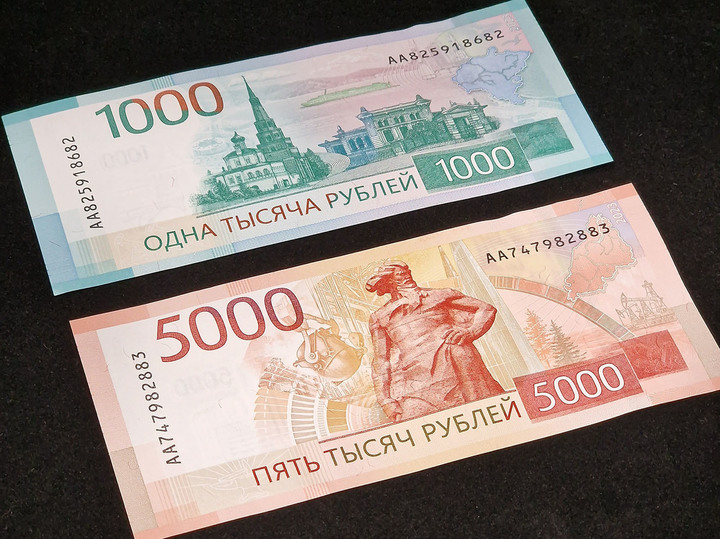
The 5,000 ruble banknote is dedicated to the Ural Federal District and its main city, Yekaterinburg. On its front side, in an updated design, Russians will see the “Europe-Asia” stele, the Sevastyanov House and buildings made in the style of constructivism, for which the capital of the Sverdlovsk region is famous. On the reverse side of the five thousandth banknote, Russians will see the monument “The Tale of the Urals” in Chelyabinsk, which is iconic for the region and is considered the embodiment of the physical strength and creative power of the Ural masters. Next to it is the “66-parallel” stele in Salekhard, which symbolizes the Arctic Circle, and in the background you can see “objects reflecting the industrial potential of the Urals,” Belov explained.
New banknotes will gradually enter circulation : old banknotes will go out of circulation due to wear or contamination, and they will be replaced immediately with new ones. Old-style banknotes, where sights of Yaroslavl were depicted on the 1,000-ruble banknote and monuments of Khabarovsk on the 5,000-ruble banknote, are no longer issued.
“Both banknotes have enhanced security features, this is a common approach,” Belov emphasized during the demonstration of the new monetary units. “The higher the denomination, the higher the security complex, making it more difficult to counterfeit.” According to him, the share of non-cash turnover in Russia currently amounts to more than 80%. As ATMs and counting and sorting equipment are ready to use new banknotes, they will begin to arrive in the constituent entities of the Russian Federation. The volume of their issue will depend on the need for cash of this denomination in a particular region.

As said by Associate Professor of the Department of Global Financial Markets and Fintech of the Russian Economic University. Plekhanov Denis Perepelitsa, the issue of new banknotes is more of an image event rather than an economic one. All banknotes are renewed as they wear out. “Nevertheless, there are a number of technical challenges: the new design of banknotes has greater degrees of protection against counterfeiters, and also allows for a slight increase in the cash supply in circulation,” the expert noted.
The main risk that Russians may face when using the new banknotes is malfunctions in the operation of ATMs, which at first may not recognize the new design of thousand-ruble and five-thousand-ruble banknotes well.
According to Artem Tuzov, director of the corporate finance department at IVA Partners, updating paper money is a technical operation that in normal times should not cause significant problems, but now the situation is different. ATMs may not accept or recognize new banknotes, and their setup will be delayed due to the fact that a number of foreign ATM operators refused to work with Russia last year, so problems with accepting updated banknotes may occur.
< p>Analysts also point out that the risk of counterfeiting and fraud remains due to the lack of awareness among citizens about the security features and design of new banknotes, although the regulator has made every effort to ensure that it is not economically profitable for criminals to even try to produce counterfeit banknotes.
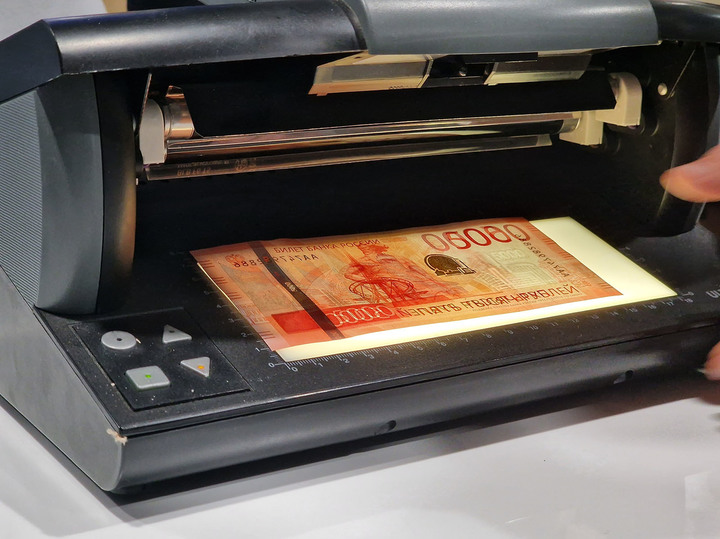
The emergence of a new design of 1000- and 5000-ruble bills became the next stage in a whole series of similar events that were announced by the Bank of Russia more than two years ago. For the first time, the regulator announced plans to completely modernize banknotes in denominations of 10, 50, 100, 500, 1000 and 5000 rubles in the spring of 2021. Statements by representatives of the Central Bank of the Russian Federation emphasized that all of them will have an improved security system, which should eliminate counterfeits. As part of the stated initiative, the Bank of Russia has already presented an updated hundred-ruble banknote in June 2023.