


Ancient skeletons appear to be hugging each other
Excavations in the Orkney Islands (Scotland) have revealed the ruins of a huge tomb, which scientists have described as a “feat of Neolithic engineering.” Traces discovered more than 100 years ago inspired archaeologists to conduct additional searches at the site of an ancient object that is 5,000 years old.
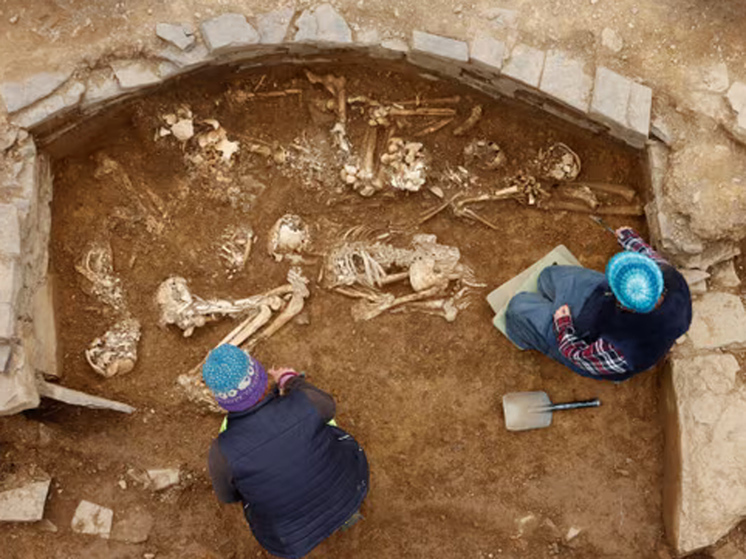 Photo: National Museums Scotland
The ruins of a 5,000-year-old tomb have been discovered in Orkney in a structure that reflects the pinnacle of Neolithic engineering in northern Britain, writes The Observer.
Fourteen articulated skeletons of men, women and children – two of them are positioned as if they are hugging – were found in one of the six chambers or side rooms.
The tomb is over 15 meters in diameter and contains a stone structure accessed through a long passage about seven meters long. The excavations were led by Dr Hugo Anderson-Wymark, Senior Curator of Prehistory (Neolithic) at National Museums Scotland, and Vicky Cummings, Professor of Neolithic Archeology at Cardiff University.
Anderson-Wymark recalled the “incredible excitement” when scientists removed the top layer of soil and were able to see the general layout of this tomb – round in shape with a rectangular chamber surrounded by six cells with curved backs. He said: “Seven or eight meters across – it's a really big interior. We found not only a tomb, but also articulated skeletons – cherry on the cake”.
He noted that the cornice design involved gradually building up stones to create cellular chambers that narrowed as they rose: “This is truly a feat of engineering. The tomb would have been a huge landmark in the landscape when it was originally built, and the stonework inside would have been very impressive.
Until now, the site has gone unnoticed as it was razed to the ground and largely destroyed without any records in the 18th or 19th centuries, when the stone was used to construct a nearby building, which was demolished about ten years ago. writes The Observer.
Further excavations in the ruins, carried out by a farmer's son in 1896, revealed traces of enclosure and discovered a stone mace head and ball, as well as eight skeletons. These findings were reported in a local newspaper by the antiquarian James Walls Cursiter, who suggested that it was a ruined tomb, but did not realize its significance or age, since he had only seen part of it.
Described at the time as a “chambered cairn,” it was only a couple of paragraphs long, which Anderson-Wymark discovered by chance during another study. This inspired him to track down this site. With the help of students from the University of Central Lancashire and local volunteers, a three-week excavation at Holme, East Mainland, uncovered evidence of a large cairn.
Most Neolithic tombs survive in Orkney as towering monuments, but Hill's the tomb was buried under green, rolling fields.
Anderson-Wymark says: “Orkney is exceptionally rich in archaeology, but we never expected to find a tomb of this size in such a small-scale excavation. It is incredible to think that this once impressive monument was almost lost without any records.
Cummings adds: “It is incredibly rare to find such burials, even in well-preserved chamber tombs, and these remains will provide new insights into all aspects of the lives of these peoples”.
A small motif remains – three lines and other scratches carved into the back of one of the stones.
Using DNA testing and other research, it is now possible to find out whether all the people buried there were related, and their connections to other Orkney tombs , some of which may have been in use for generations or hundreds of years.
Anderson-Wymark says: “They certainly put bodies on top of bodies, but they seem to have disintegrated over a period of time.” .
The entrance may have been covered with a stone slab, allowing them to return inside, perhaps for various events and ceremonies in the main hall.
The tomb dates back to around 3000 BC, when local communities have been farming in Orkney for several hundred years. They focused on raising cattle, and thousands of years later this field is still used for the same task…