


Russian currency reacted violently to events in Kursk region
The ruble surprised by collapsing in over-the-counter trading by 8.8% in a matter of days — from 84.9 to 92.6 per dollar. In some ways, the situation resembles the scenario of the first week of December 2022, when the «American» rate rose by 11.3% — on a low base of a protracted, seemingly endless over-strengthening of the ruble. Both then and now, the main triggers were factors that had a powerful international resonance: in 2022 — the embargo imposed by the West on Russian oil supplies by sea, in 2024 — the events in Kursk region.
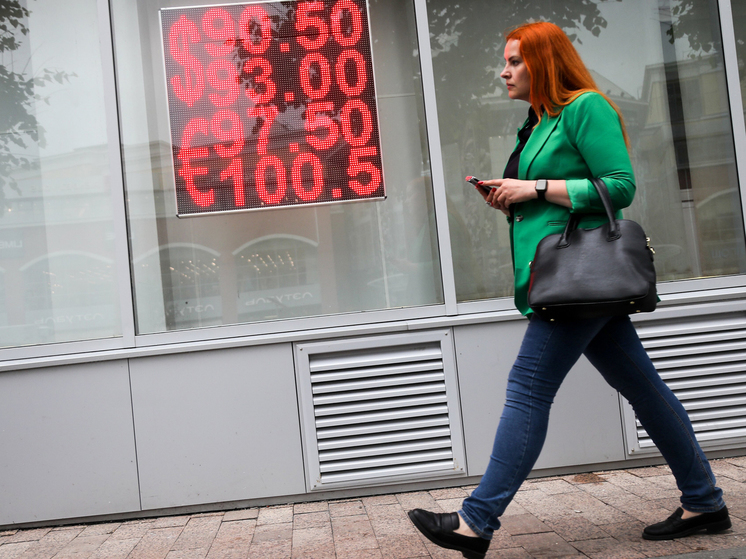
Moreover, the fresh «Kursk syndrome» was superimposed on a tangle of other circumstances. These include the sanctions imposed by Washington on June 12 against the Moscow Exchange and the National Clearing Center, a decrease in import volumes due to problems with payments to China, Turkey, and the UAE, a seasonal surge in demand for currency for foreign summer vacations, and a general structural transformation of the economy under the pressure of sanctions.
Until recently, it might have seemed that the ruble exchange rate had reached a certain equilibrium value of around 85-86 per dollar, which would remain for a long time. And now, after two months of relative stability, it once again confirmed its historical properties: volatility, unpredictability, and tendency to devaluation. Moreover, today, when classical exchange trading has been suspended in Russia, these qualities have acquired a completely skewed, opaque character. If earlier the exchange rate was determined by the market, now it is determined by large banks, exporters and the state represented by the Central Bank.
And that's not even the worst of it: in conditions where there are no non-residents, when the US has sharply tightened sanctions control over foreign counterparties of Russian businesses, and they, in turn, have stopped accepting payments from the Russian Federation, it is becoming increasingly difficult for financial authorities to eliminate the imbalance between the demand and supply of currency.
“First of all, the exchange rate dynamics were influenced by events in the Kursk region,” says leading expert at the Center for Political Technologies, economist Nikita Maslennikov. “They affected the feelings and psychology of those foreign players who have close trade and payment relations with us. They previously assessed the ruble as a risky asset, but now, against the backdrop of geopolitical aggravation, there is no need to talk about high risk appetite. Currency supply was already very sluggish, especially from China, and now it has decreased even more. The strengthening of the ruble against the yuan is also not helped by unclear macroeconomic statistics in China. There, in the second quarter, GDP growth rates slowed to the lowest level in the last five quarters — to 4.7% year-on-year, while in January-March the figure was 5.3%.
According to Maslennikov’s forecast, until the end of August the ruble will be in the range of 90-93 per dollar. After which it will go to around 90. The situation may well even out, the interlocutor of MK believes, recalling, in particular, the upcoming tax period, that in the fall there will be clarity with the draft budget for the next three years (the corresponding forecast of the Ministry of Economic Development will be published, including number at the ruble exchange rate). In addition, in the fall, new settlement mechanisms for foreign trade transactions in cryptocurrency, supervised by the Central Bank, may be launched in test mode.
“Since our official ruble exchange rate is determined by cross rates of foreign currencies, I do not understand why it failed only in relation to the dollar and the euro, while paired with the yuan there is no such noticeable weakening — only from 11.9 to 12, says Igor Nikolaev, chief researcher at the Institute of Economics of the Russian Academy of Sciences. — This suggests that the indicator was somehow artificially “twisted” to the values needed by the state. Let me remind you: according to the scenario conditions for the development of the Russian economy, the average annual dollar exchange rate in 2024 is set at 94.7 rubles. This figure forms the basis of the forecast, in accordance with which the budget for the next three years will be adopted. The spending obligations of the federal treasury must be fulfilled.”
Oil prices have returned to above $80 per barrel Brent, which certainly cannot be called low. The situation with the ruble was clearly affected by another round of geopolitical tensions, Nikolaev sums up.