


Scientists were able to fill in the gaps in the periodic table
The James Webb Space Telescope and other observatories witnessed a powerful explosion in space, which resulted in the formation of rare chemical elements, some of which are necessary for life.
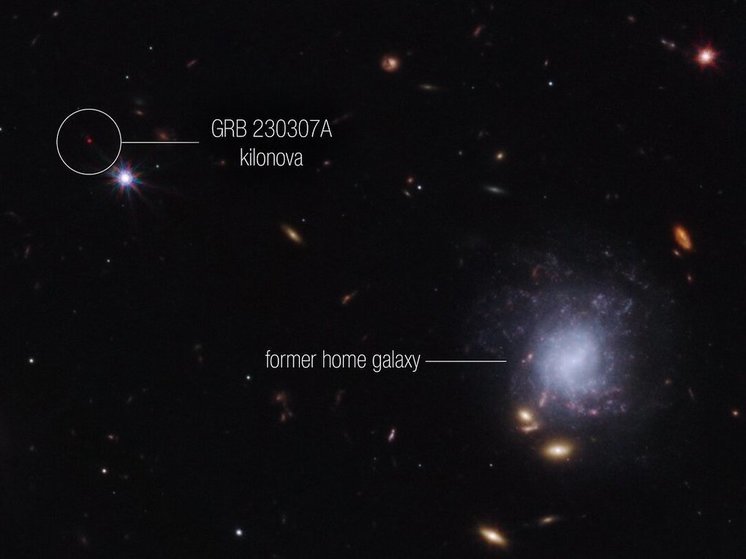 Photo: esawebb.org
The explosion, which occurred on March 7, was the second brightest gamma-ray burst ever observed by telescopes in more than 50 years of observation, more than a million times brighter than the entire Milky Way galaxy combined. Gamma-ray bursts are short bursts of the most energetic form of light, CNN explains.
This particular burst, named GRB 230307A, was likely formed when two neutron stars—incredibly dense remnants of stars from a supernova explosion—merged in a galaxy about a billion light-years away. In addition to releasing gamma rays, the merger resulted in a kilonova burst, a rare explosion that occurs when a neutron star merges with another neutron star or black hole, according to a study published Wednesday in the journal Nature.
“Only a few kilonova flares are known, and this is the first time we have been able to see the effects of a kilonova using the James Webb Space Telescope,” says lead study author Andrew Levan, professor of astrophysics at Radboud University in the Netherlands. Levan was also part of the team that first detected the kilonova flare in 2013.
In addition to the Webb telescope, NASA's Fermi Gamma-ray Space Telescope, the Neil Gehrels Swift Observatory, and the Transiting Exoplanet Observation Satellite observed the flare and tracked it before the merger of neutron stars. Webb was also used to detect the chemical composition of tellurium after the explosion.
Tellurium, a rare metalloid, is used to color glass and ceramics and plays an important role in the manufacturing process of rewritable CDs and DVDs, according to the Royal Society of Chemistry. Astronomers expect that other elements close to tellurium on the periodic table, including iodine, which is essential for most life on Earth, will likely be present in the material released by the kilonova.
“It's been just over 150 years since Dmitri Mendeleev compiled the periodic table of the elements, and now we're finally able to start filling in those last gaps in understanding where everything was created, thanks to Webb,” Levan said.
Astronomers have long believed that neutron star mergers are celestial factories that create rare elements heavier than iron. But it was difficult to find evidence.
Kylon stars are rare phenomena, which makes them difficult to observe, CNN notes. But astronomers look to short gamma-ray bursts, which last about two seconds at most, as characteristic byproducts of rare events.
What was unusual about this burst was that it lasted 200 seconds, which makes it a long-lasting gamma-ray burst. Such long-lasting outbursts are usually associated with supernovae, which are formed when massive stars explode.
“This surge falls into the long category. It's not that close to the border. But it appears to be coming from a merging neutron star,” study co-author Eric Burns, assistant professor of physics and astronomy at Louisiana State University, said in a statement.
Fermi initially discovered the gamma-ray burst, and astronomers used ground-based and space-based observatories to monitor changes in brightness after the explosion in the gamma, x-ray, visible, infrared and radio wavelength ranges of light. Rapid changes in visible and infrared light suggested that it was a kilonova.
“This type of explosion occurs very quickly, and the material in the explosion also expands quickly,” study co-author Om Sharan Salafia, a researcher at the Brera Astronomical Observatory at the National Institute of Astrophysics in Italy, said in a statement. “As the entire cloud expands, the material cools rapidly, and its peak glow becomes visible in the infrared and becomes redder within days or weeks.”
The team also used the Webb telescope to trace the path of the neutron stars to how they exploded.
They were once two massive stars in a binary system that existed in a spiral galaxy. One of the pair exploded as a supernova, leaving behind a neutron star, and then the same thing happened to the other star. These explosive events ejected the stars from their galaxy, and they remained paired, traveling 120,000 light-years before merging several hundred million years after they were ejected from their home.
Astronomers have been trying for decades to determine how chemical elements are formed in the universe, CNN continues.
Detecting more kilonova flares in the future with sensitive telescopes like the Webb Telescope and the Nancy Grace Space Telescope, scheduled to launch in 2027 , could provide clues about what heavy elements are formed and released in rare explosions.
Researchers also want to find more mergers that create longer-lasting gamma-ray bursts to determine what drives them, and whether there is a -connection with the elements created in the process.
The turbulent life cycle of stars distributed the elements contained in the periodic table throughout the universe, including those needed to form life on Earth in the first place. The ability to study kilonova-like stellar explosions in recent years is allowing scientists to answer questions about the formation of chemical elements, providing insight into how the universe has evolved over time.