


The meeting lasted more than three hours
Vladimir Putin on Wednesday evening answered questions from the leaders of the world's leading media for more than 3 hours (until 23.35). The meeting was attended by 16 people — equally from friendly and unfriendly countries. Unfortunately, some journalists were poorly prepared for the dialogue and asked Putin questions that he had already answered.
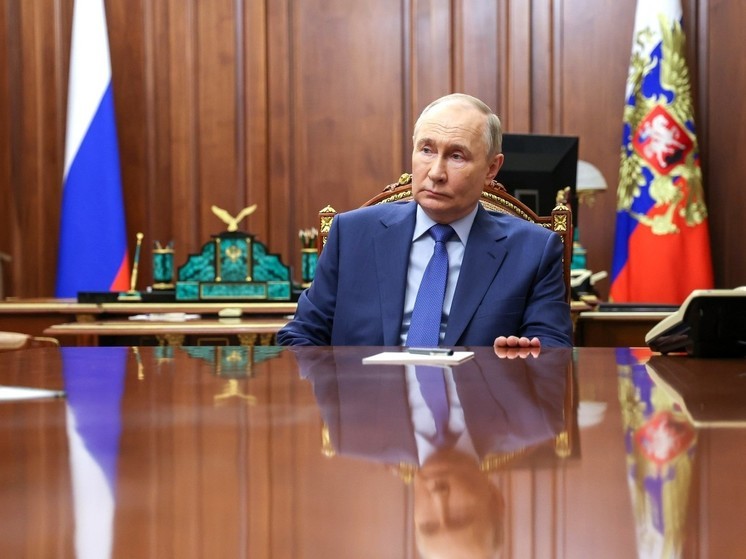 photo: kremlin.ru
However, the president considered it necessary to add several important points to his theses. He called not to consider the possibility of Russia using tactical nuclear weapons with a yield of 70-75 kilotons as a bluff and promised to find an opportunity to strike sensitive targets in Western countries in response to the supply of long-range missiles to Kyiv.
It is no secret that the Russian bureaus of Western news agencies were empty after the start of the SVO. The management tried to remove as many employees as possible — primarily foreigners. Nowadays, a maximum of 3-4 people work in the offices, mostly with Russian passports. And the first persons had to travel to the meeting with Putin on stage. However, no one refused. (For various reasons, in the end, the Indian, Egyptian and Brazilian did not reach St. Petersburg, while all the “Westerners” arrived)
The Kremlin decided to invite everyone, regardless of their views, attitude towards the Northern Military District and the status of unfriendly countries. Moreover, the world's main agencies work in such countries. As Dmitry Peskov explained, these media form global information flows and are trendsetters in information fashion. This is a unique chance for them to hear the truth first-hand and understand Russia’s position, the press secretary is sure.
The meeting was scheduled at the Lakhta Center, and the president was very late for it. The culprit in this, as VVP himself said, was the head of Gazprom, Alexey Miller, who gave the head of state a tour of his brainchild. It was impossible to escape from his tenacious clutches, complained VVP. Mr. Miller paid attention to every detail, was ready to talk about it for hours and was simply “infectious with his optimism.” “They probably kept you here for half a day. I apologize for this,” Vladimir Putin sympathized with the journalists.
Traditionally, the woman has the right to ask the first question. Moreover, from the most friendly country to Russia. A representative of the Belta agency asked how the relationship between Putin and Lukashenko is developing and whether there are politicians among the leaders of Western countries with whom it is possible to build the same constructive dialogue. Next, Samia Nakhoul, editor-in-chief of global news at Reuters, took the floor. Introducing the journalist, the presenter said that she was very seriously wounded in Iraq, and this fact of her biography attracted the attention of Vladimir Putin. The President asked in what year and under what circumstances this happened. But when I heard about the 2003 invasion, I did not pursue the topic.
To be honest, Ms. Nakhul did not prepare for the meeting in the best way. At least Putin already answered the first question she asked. And more than once. It concerned the future of the US President, which would be more preferable for the Russian Federation. VVP just recently said that Biden is preferable for Moscow, primarily due to his predictability. And he repeated this explanation again. “Although by and large we don’t care.” According to Putin, Trump’s hypothetical rise to power most likely will not change anything in relations between the two countries and will not affect the supply of weapons to Ukraine. “Nobody in the United States is interested in Ukraine, they are interested in the greatness of the United States,” the president said, noting that Washington does not want to allow Russia to succeed on the battlefield, because it believes that this will damage US leadership. “That’s the whole point,” he says.
The head of the German DPA news service, Martin Romanczyk, asked what awaits Germany after Olaf Scholz agreed to supply long-range weapons to Ukraine. “Did you somehow warn or maybe threaten the Chancellor after he made this decision?” — asked Romanchik with concern. This question sincerely made Vladimir Putin laugh. “Why did you decide that we were threatening someone? We are not threatening anyone. Especially the head of another state. This is bad manners,” he assured, laughing. However, according to GDP, nothing good seems to await Scholz himself, and Germany as a whole. Putin hinted at possible problems for Scholz’s party in the next elections — polling data, which, as it turned out, was supplied to him by “reliable German friends”, indicates the dissatisfaction of voters.
As for Germany, Putin believes that it has never been a truly sovereign state. However, recently, by following US orders, Berlin has been causing direct damage to its economic interests. Purchasing LNG is much more expensive than pipeline Russian gas and undermines the competitiveness of the German economy. “The German economy is a locomotive. If she sneezes and coughs, the whole of Europe will get the flu,” Putin explained. And he pointed out the erroneousness of the policy of the Scholz government, which, in his opinion, should have directly told the United States that Germany would not allow its economy to be undermined.
Questions from representatives of Western agencies were interspersed with questions from journalists from friendly countries. In total, 16 people attended the meeting — 8 from the “collective West” and ideologically close Japan and South Korea, and 8 from their closest partners. These are Belarus, Azerbaijan, Kazakhstan, Uzbekistan, China, Iran, Belarus and Türkiye. It is worth noting that they all followed the example of the Belt representative and asked mainly about Russia’s relationship with its countries. And they received detailed and, I must say, very optimistic answers to their questions.
The most pressing question was asked by the editor-in-chief of the European Information Francepress, Karim Talbi, who asked about Russian losses in the Northern Military District. Putin still did not name any “his” figures. However, he shared the “Ukrainian” ones: the Armed Forces of Ukraine, according to him, lose 50 thousand people every month, of which approximately half (25 thousand) are irretrievable losses. “Our losses are several times smaller,” he assured and, for clarity, cited prisoners as an example. According to the president, there are 6,465 Ukrainian soldiers and officers in Russian captivity. And in Ukrainian there are 1348 of our soldiers. “And in terms of irreparable losses, the ratio is the same — one to five,” Putin said. In other words, we can calculate: if Ukraine has 25 thousand dead monthly, then Russia has 5 thousand.
Deputy Editor-in-Chief of the Italian ANSA Stefano Polli also asked a question that had already been asked just last week in Uzbekistan — about the possible consequences for European countries of Western weapons strikes on targets in Russia. Putin repeated his previous answer. However, he made an important addition. Russia, according to him, can respond asymmetrically: in particular, by supplying its weapons to those regions of the world from which strikes will be carried out on sensitive objects of countries that are suppliers to Kyiv. The first thing that comes to mind is, of course, Syria and the DPRK. However, it is not entirely clear which sensitive Western objects they can strike? American military bases? Unfortunately, Mr. Polli did not insist on clarification.
The Associated Press representative's question developed the Italian's question. However, Vladimir Putin considered it his duty to explain to him that the conflict in Ukraine can be stopped very quickly. And President Biden knows this. He, according to Putin, wrote a corresponding letter to the Kremlin, to which he received a corresponding response. “Stop supplying weapons to Ukraine, and hostilities will stop in a maximum of 3 months,” VVP retold his meaning.
At the end of the meeting, Samia Nakhul from British Reuters suddenly perked up again. During the three hours of the meeting, she managed to come up with a new, however, very predictable question. “What could trigger a nuclear war and how close are we to it?” — asked the journalist. Vladimir Putin responded by complaining that he was being forced to wave a nuclear baton and suggested looking into the nuclear doctrine of the Russian Federation, where everything is written. “For some reason in the West they believe that we never use tactical nuclear weapons,” VVP shrugged, recalling that the doctrine allows for their use if someone’s actions threaten the sovereignty of the Russian Federation. “This cannot be taken lightly or superficially,” he warned. Putin recalled that Russia has tactical nuclear weapons with a yield of 70-75 kilotons. Therefore, it is better not to bring Moscow to the point of using it. And even before such a threat.