


“One of the outstanding discoveries of recent decades”
“One of the outstanding discoveries of recent decades” was made by scientists who found themselves in possession of an ancient gold coin depicting an unknown British king.< /p> 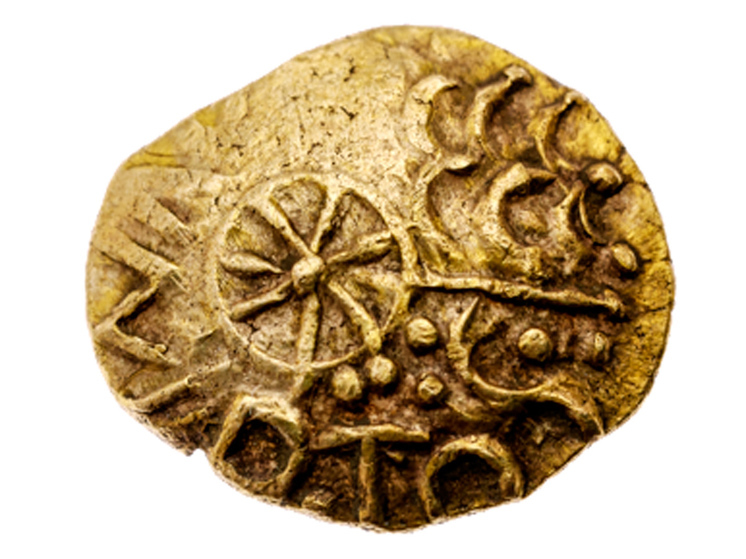
New light has been shed on a little-known part of British history thanks to the unusual discovery of a coin bearing the name of a forgotten Iron Age ruler in Hampshire, southeast England.
According to Arkeonews, the coin with the inscription “Esunertos” was discovered by a metal detector in a field in Hampshire. Experts speculate that Esunertos may have ruled as king from the mighty Fort Danebury, and the find has been called «one of the outstanding discoveries of recent decades.»
The coin, believed to have been produced between 50 and 30 BC, was minted in connection with Julius Caesar's first Roman raid on Britain in 55 BC, when the Roman general and his 20,000 soldiers landed on the Kent coast. In addition to encountering Celtic warriors on the shore, the Romans had difficulty landing due to rough seas and were eventually forced to return home.
Gregory Edmund, Iron Age coin specialist at Spink Auctioneers, comments: &ldquo ;This stunning piece of prehistoric art adds to the mental image we have when we think of Iron Age Britain – war horse and chariot. But we are also surprised by the emergence of classical languages such as Latin.
Dr John Sills, from the Ashmolean Museum's Celtic Coins Department, said: «This is one of the outstanding discoveries in Celtic numismatics of recent decades.»
The gold coin was initially expected to fetch around £4,000 ($5,000) at auction ). But against all odds, it broke the Spinks auction record, selling for an astonishing £20,400 ($25,500), reports the Daily Mail.
The coin was found by Lewis Fudge, a metal detectorist who was given permission to search a farmer's field in March this year. Fudge expressed his delight by declaring, “I'm over the moon. If it weren't for the people in the auction room, I would have been jumping around. Collectors I've spoken to are stunned. I'm so glad I didn't take advantage of their private offers before the auction. It's incredible to think that my find has created its own Wikipedia page.
Spink Auctions describes the coin as a quarter slater with the obverse inscribed with the name Esunertos in Latin and with the worn head of Apollo formed by three interlocking rows outward-facing crescents, a wheel with seven spokes in the center instead of an ear and an eye with diverging rays.
The reverse of the coin depicts a horse with a triple tail, a claw-shaped lower jaw on the muzzle and a linear ear, with a granular mane, a collar or bucranium above the head, a wheel with 8 spokes at the top, piercing the horse's back, and a double or triple ring at the bottom.